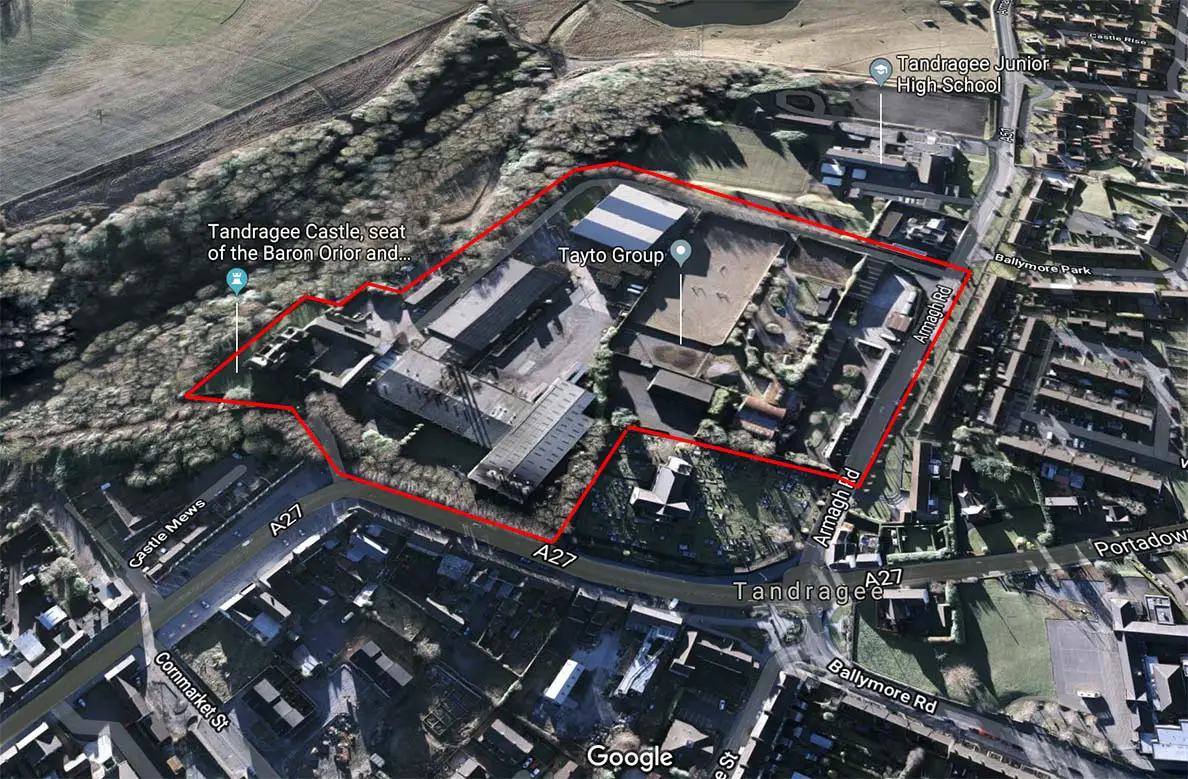
Co Armagh crisp giant Tayto now has approval in the bag to build 34 houses within the former walled garden of its historic Tandragee Castle home.
And new warehouse facilities, with an extension to the factory and basement car parking, have also been approved at the top-of-the-town site too.
It’s almost two decades since collective plans – part of a mixed-use development for residential and warehouse – were mooted, submitted in 2008 and then subsequently turned down.
But the Planning Appeals Commission overturned that decision and outline approval was granted back in 2015.
Fast forward three years and two required reserved matters applications were lodged and have just this week been approved.
The reserved matters applications provide more details of what the housing development and new factory facilities would actually look like.
In all, four different types of houses are proposed, all two-storey homes, both detached and semi-detached, of varying sizes and some with garages. There would also be a central public amenity space.
The plans would involve the demolition of some existing outbuildings.
And a new vehicle and pedestrian access would be constructed from the Armagh Road.
The housing plans, by Tayto NI, is for a site “to the north of Tandragee Castle within its former walled garden”.
It would be built on lands 32m to the west of St Mark’s Church Of Ireland, around 50m north of the Tayto Castle Factory Tandragee and 75m east of Tandragee Junior High School
A revised landscape management plan completed in March 2026 describes the site as “relatively flat” and “bounded by stone and concrete walls of varying heights on all sides”.
It adds: “There are a number of buildings/structures on the site, ranging from stone and brick walls, some of which are retaining, to a B&B, the former gardener’s cottage, modern stables, barns and outbuildings.
“The site comprises mostly buildings, areas of hardstanding of various types (gravel, setts, concrete) and a large horse arena to the south. A few areas are set in grass and there are a number of sporadic trees/shrubs throughout the site.
“The north-eastern boundary of the site has an area of vegetation extending from the Armagh Road to the church hall to the south. A tree lined access road to the Tatyo factory is located outside the former walled garden to the west.”
The existing trees forming the approach to the Tatyo factory will be retained.
A large area of public open space will be formed in the centre of the site and a tree lined pathway will be created to “link the new open space to the tree lined approach to the factory”.
The plan adds: “A 10m wide barrier planting strip will be formed along the entire length of the southern boundary to act as a buffer between the new housing development and the existing factory further to the south.
“The existing area of lawn and trees to the south of the B&B will be altered slightly but, to all intents and purposes, it will be retained.
“The vegetation along the north-eastern boundary and a number of individual trees will be retained.”
There would be further ‘buffer’ planting between the new housing development and the existing factory.
ABC Council planners, in their official report, felt that the development “respects the surrounding context”.
Located “beside a church, factory, police station and residential properties”, the development would sit “behind a stone wall that runs along the Armagh Road” and “views of the site from public vantage points are limited”.
It was also “respectful” of the density of other housing in the area, officials found.
With all of the planned houses two-storey, officers also believed these to be “in keeping with surrounding development”.
There were no concerns of any impact on “features of the natural environment”.
Their report explained: “The site is currently used for agricultural purposes and for the exercising and housing of horses and therefore the majority of the site is largely devoid of any mature vegetation or trees, with the exception of some hedgerows and trees to the middle of the site surrounding the sand arena, and some semi mature trees and shrubs within the stable area.
“Existing mature vegetation on the boundaries of the site is to be retained. The proposal does not involve the loss of any significant areas of existing landscaping.
“This proposal includes the provision of an area of open space to the centre of the site and two smaller pockets of landscaping to either side of the access, and to either side of the pedestrian access onto the Tayto estate road.
“In addition to this, it is proposed to provide buffer planting along the current boundary wall between this site and the adjacent factory grounds.
“Alongside this, it is proposed to plant trees along the boundaries and in some of the front gardens; those to be planted along the western boundary along the access to the factory site are to be oak, while the remainder within the site will be a mix of ash, alder, birch and rowan trees.”
In terms of noise mitigation, a warehouse development – for which a separate reserved matters application has just been approved – would “provide a physical barrier between the factory and the proposed dwellings”.
With the exception of two houses which will be accessed from Armagh Road, the development will be built around the main area of open space and one cul-de-sac.
All new houses will face the estate road.
Planners say that while this is to ensure the protection of the historic wall along the Armagh Road, it also “means that the orientation of the properties will facilitate surveillance and help to deter crime and promote personal safety”.
The plans will see one new access onto Armagh Road, which will be taken from the point in the existing wall which is not described as ‘historic’.
DfI Roads were consulted and raised “no objections”, subject to conditions, and planning officers were therefore “satisfied that the access arrangements, internal layout and parking arrangements will not prejudice road safety or significantly inconvenience the flow of traffic”.
There were no objections from Environmental Health.
Historic Environment Division was also satisfied that it met policy requirements, subject to conditions for the “agreement and implementation of a developer-funded programme of archaeological works”. This was to “identify and record any archaeological remains in advance of new construction, or to provide for their preservation in situ”.
It found there would be no “demonstrable harm” to listed buildings in the area, including St Mark’s Church of Ireland.
There had been two letters of objection received from one address, most of which related to the history of the Tandragee Castle site.
They had described it as an “historic site like Navan Fort” with “bronze age and iron age history”, adding: “This would be Tandragee’s final ‘wipe out’ if the castle gates, wall and walkway were to be demolished.”
They also detailed “safety” concerns and pointed out: “There are more houses in the town than shops and businesses.”
Planners, however, in considering the objections, noted: “This proposal does not seek to remove the castle gates, wall or walkway. There is no development immediately adjacent to the wall and walkway that runs along Church Street. Officers therefore give no weight to these points.”
In relation to the ‘more houses than shops and businesses’ argument, they added: “The application site is outside the main commercial areas of Tandragee which are centred around Church Street and Market Street.
“The site is within the settlement limits of Tandragee and, as such, there is a presumption in favour of development, subject to all other planning and environmental considerations.
“In this case the principle of development has been established through the granting of outline planning permission by the Planning Appeals Commission.”
Aside from the housing, a reserved matters application has been approved in relation to the “erection of warehouse and basement car park, and extension to existing factory at Tayto Castle, Tandragee, comprising ground floor warehouse extension, basement car park, surface car parking, road alterations, landscaping and all associated site works”.
The warehouse is to link with an existing building and is finished in corrugated metal roof and wall cladding with a clad canopy over the loading bays.
The area is bounded by the former PSNI station and Tandragee Junior High School.
The planners report explains: “The area to be developed as part of this proposal is an existing yard area within the factory complex. This proposed building and underground car parking is to be located in an area of existing tarmac hardstanding/car parking between the existing three modern factory/warehouse buildings and an existing stone wall located to the north.
“The proposal also includes additional surface car parking to the south of the existing buildings. This is predominantly on land which is grassed but will include an area of existing tarmac.”
Again, there were two objections from the same address, while a letter was also received from the principal of Tandragee Junior High, which advised the school and its Board of Governors were “broadly in support of the development”.
But they “sought assurances that the integrity of their site and the access to the school on the Armagh Road and perimeter would not be compromised”. Tandragee High was also keen that “any future development has cognisance of road safety requirements for pupils and their families travelling to and from the school”.
In their report, planners found that the plans as submitted indicated that the “integrity of the school site, its perimeter and its access will not be compromised”.
But in relation to road safety, they added: “This is not a matter for officers to consider; any road safety issues beyond those relating to the creation of a safe access, the generation of traffic and the provision of adequate parking and manoeuvring areas is a matter for the PSNI.”
Overall, as with the new housing, they said the principle of development had been established through the decision taken by the Planning Appeals commission to allow an appeal on the previous outline application, “subject to conditions”.
And they add: “It therefore follows that, subject to any countervailing material consideration that outweighs the presumption, the proposal should be granted planning permission such that the principle to develop the area of the site, for Class B4 (Storage or Distribution), is considered acceptable.”
The applicant, Tayto, will now be notified of the decisions made in relation to both reserved matters submissions.