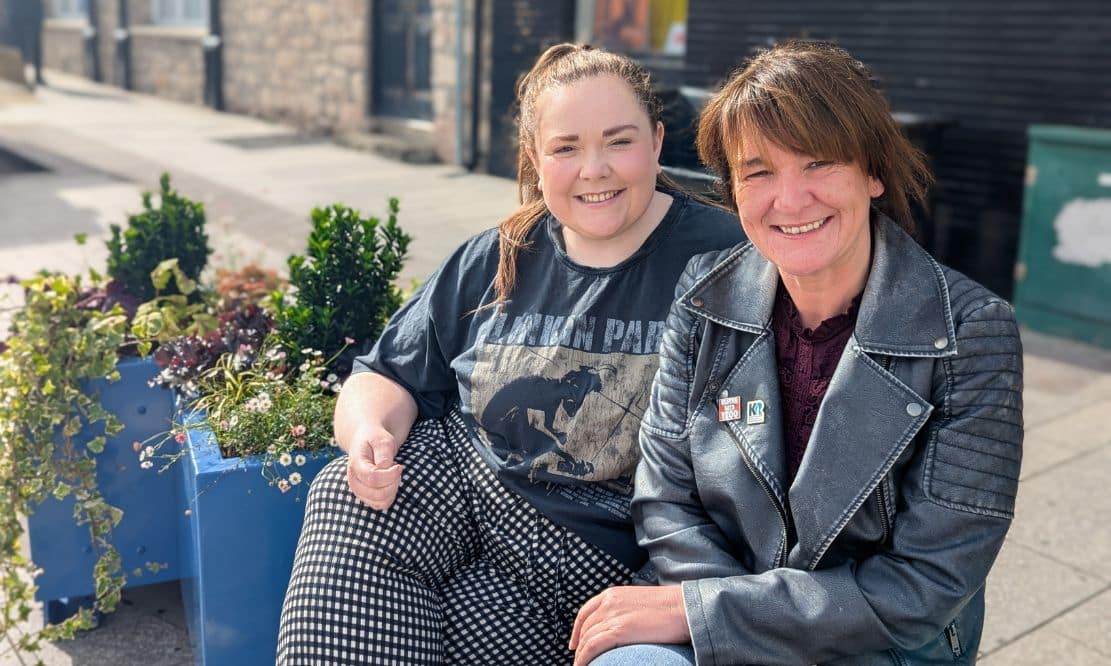
Two Co Armagh women living with a debilitating disorder that causes them to experience a range of physical – and often painful – symptoms are attempting to change public perceptions and reach out to others who may need nothing more than a listening ear.
Colleena Loughran (33) and Emma McAnallen (44), both from the Armagh area, have each received a diagnosis of Functional Neurological Disorder (FND) after long battling to find answers for their deteriorating health.
The condition is characterised by charity FND Matters NI as being “relatively unheard of”, however, they also note that it’s “one of the most common causes of neurological symptoms”.
The charity say: “Functional Neurological Disorder is a real and genuine condition. There is a problem with how the brain and nervous system send and receive signals. FND is due to a complex combination of factors disrupting how the body and mind is interacting and working.
“In conditions, such as Multiple Sclerosis (MS) and Parkinson’s, disease and damage is present, but with FND there is no structural damage or disease but rather a functional problem. Yet symptoms can be just as severe and disabling.”
Speaking to Armagh I, the women described having experienced functional seizures, dystonia, limb weakness, excruitiating pain, fatigue, brain fog and cognitive issues with memory and concentration.
While they shared many similarities in how their condition manifests itself, they also expressed how it can often vary from person-to-person.
One thing both were emphatic about, was their heartbreak and frustration about the way FND is often viewed by the public and even medical professionals.
Making it clear, they do not blame anyone for having preconceived notions about FND, they also emphasised the need for change, and above all, the need for kindness.
So far, Colleena and Emma have been put in contact with at least three other women in the Co Armagh area living with FND.
Those women also wished to meet with Armagh I to discuss their own journeys, but sadly, due to a “flare” in their symptoms were unable to make it in person.
Colleena said it all started for her in August 2023, explaining: “Mine came with a blow. I was fine one day and the next, I wasn’t. I had a twitchy eye for a long time and my GP told me I had to eat more cheese, which didn’t make sense! In the space of an hour my entire face started twitching and then I was in a full blown seizure and couldn’t breathe.”
When she was taken to hospital, she was advised “it’s just stress”. But the young mum was adamant that she had no more stress than anyone else in her position. The main source of her stress, ironically, was the sudden onset of worrying physical symptoms.
Colleena continued to “get worse” as time went on, despite taking the Diazepam she was prescribed to help with her “stress”. Again, following another more serious seizure a few months later she returned to hospital where she stood her ground insisting to be seen by neurology.
She was discharged again, this time with “FND” mentioned on her notes. She said she was never informed of this at the time.
While Emma shares a similar story to Colleena, she sadly suffered two decades of paralysis, pain and seizures without any mention of FND coming into play.
Explained Emma: “I was travelling from Dungannon to Moy and the right side of my face went into paralysis. I drove straight to out of hours and was told it was Bell’s palsy.”
Emma was given medication to help treat the facial paralysis and “just went with it!” However, the issue kept returning. Eventually, she was referred to Neurology and advised she had chronic migraines and a condition called hemicrania continua – in layman’s terms a serious and continuous migraine.
Later, Emma was again stricken whilst travelling. This time, it was a terrifying episode that affected her limbs.
“I was travelling down the motorway and all my left side went into paralysis,” she said. On this occasion she was advised she possibly had a transient ischemic attack (mini-stroke), however, this was never formally confirmed.
“In hindsight I was physically very ill. I was exhausted and sleeping for 12 hours,” added Emma. And despite the severity of her symptoms then, she says they were not “as severe” as they are today.
Both women experience “functional seizures” where they are aware of their surroundings while the seziure is occurring. On occasion, they can also walk and talk during an episode. On other occasions, they are completely overcome. Their seizures are also known to last hours at a time and can be repeated within a single day.
Colleena advised she has experienced around 40 seizures in a 24-hour period.
And, while speaking to this publication, Emma suffered at least four sudden onset seizures affecting her facial muscles. During these episodes, the right side of her face contorts, restricting her ability to speak. Once the episode has passed, she also suffers with periods of mild disorientation and confusion.
The women advised that in Northern Ireland there is no clear “pathway” for FND diagnosis or treatment. As such, many sufferers are on different treatment plans or left entirely undiagnosed and therefore untreated.
Symptoms are often blamed as being stressed-induced or a result of anxiety or poor mental health. And while the women agree that poor mental health can worsen their symptoms, they argue instead that poor mental health comes as a result of “not being believed or listened to”.
Because people with FND usually suffer what are regarded as “functional seizures” – where they can continue to communicate or move during an episode – they are often accused of “faking”, said Colleena and Emma.
Hospital tests also frequently come back negative and their pain can not be seen or measured. A diagnosis of FND is a “diagnosis of exclusion”, meaning all else must be ruled out by medical professionals in order for the diagnosis to be given.
There is no one definitive, conclusive test that can determine whether a person is suffering with FND or not.
All of this can lead to members of the public – and at times, sufferers’ families – making the assumption that those with the condition are “making it up for PIP”, said the women.
“So many people say you are faking it or it’s not real. It’s never, ever treated seriously,” said Emma. “My opinion is I was treated like I was mentally unfit.”
Colleena said medical professionals who first assessed her “saw me as a new mother who wasn’t coping or was stressed.”
The young mother also used to share her experiences on TikTok to help raise awareness and interact with others experiencing similar symptoms. However, it wasn’t before long that online trolls put paid to her endeavour, harassing her with constant comments claiming her to be “putting it on”.
Emma said: “Why would anyone want to pretend to go through what we are going through every day. We want to be able to go on a night out, or travel and not warn people that we might have a seizure. We just want to do normal things and live normal lives.”
They also say their partners and families go through so much to support them and cannot thank them enough. Both Colleena and Emma’s partners play massive roles as carers and have had to adjust their lives considerably to support them.
Colleena also advised that PIP payments are not always available to those living with FND. According to PIPexpert.com, “Some assessors still treat FND as a psychological condition that patients could overcome if they tried. This is medically incorrect. FND is classified as a neurological condition by the WHO (ICD-11), NHS and all major neurological organisations.”
The website calls for those living with the condition to challenge denied applications on the grounds that “FND is a recognised neurological condition. My symptoms are involuntary and not under my conscious control.”
Ultimately, both women feel strongly that public perception needs to change. They are both asking for nothing more than “kindness and patience”.
Especially among medical professionals, whom they vehemently praise, but say can often be dismissive of their symptoms… both new and reoccurring.
They said: “Instead of saying, ‘Oh you’re having a good day today so you must be alright’ or ‘Maybe you’re not sick and it’s gone away’, just ask how someone is doing or empathise.
“If you see us – or anyone – using a disabled parking space with a blue badge, don’t accuse them of using someone else’s badge or insinuate they aren’t disabled. So many disabilities are unseen and it doesn’t change what that person is experiencing internally.”
Neither expects or wants sympathy. All they ask is that they are treated with respect and offered the right support when it’s needed.
And while they would love to see the NHS in Northern Ireland create a pathway to diagnosis and treatment for FND, they are currently focused on creating a network for sufferers, where an understanding, listening ear is always available.
Emma and Colleena encourage anyone who wishes to speak with them to make contact via info@armaghi.com to be put in touch directly.