It was a momentous day in the history of rail travel but, for us as a city, for all the wrong reasons.
Now, just shy of seven decades later, the commitment and drive to reverse what was being witnessed and re-open the Armagh to Portadown line continues apace.
That would not – or could not – have been happening, of course, without the ongoing efforts of the Portadown Armagh Railway Society.
From small beginnings, the Society has worked tirelessly in the background to see the rail line reopened, along with Armagh City, Banbridge and Craigavon Borough Council, the Department for Infrastructure, Translink and other interested parties.
As a result of this work, a scoping study, technical study and feasibility study have been undertaken by professional consultants and – according to PARS chairman William Hutchinson – “with promising potential outcomes”.
The next phase, which will take the form of an outline business case, is to follow shortly, when appropriate funding becomes available to get the job done.
With all that is going on in the background, it would be entirely remiss not to reflect on this important date – a day on which Armagh lost that vital link – and again look to the future with hope.
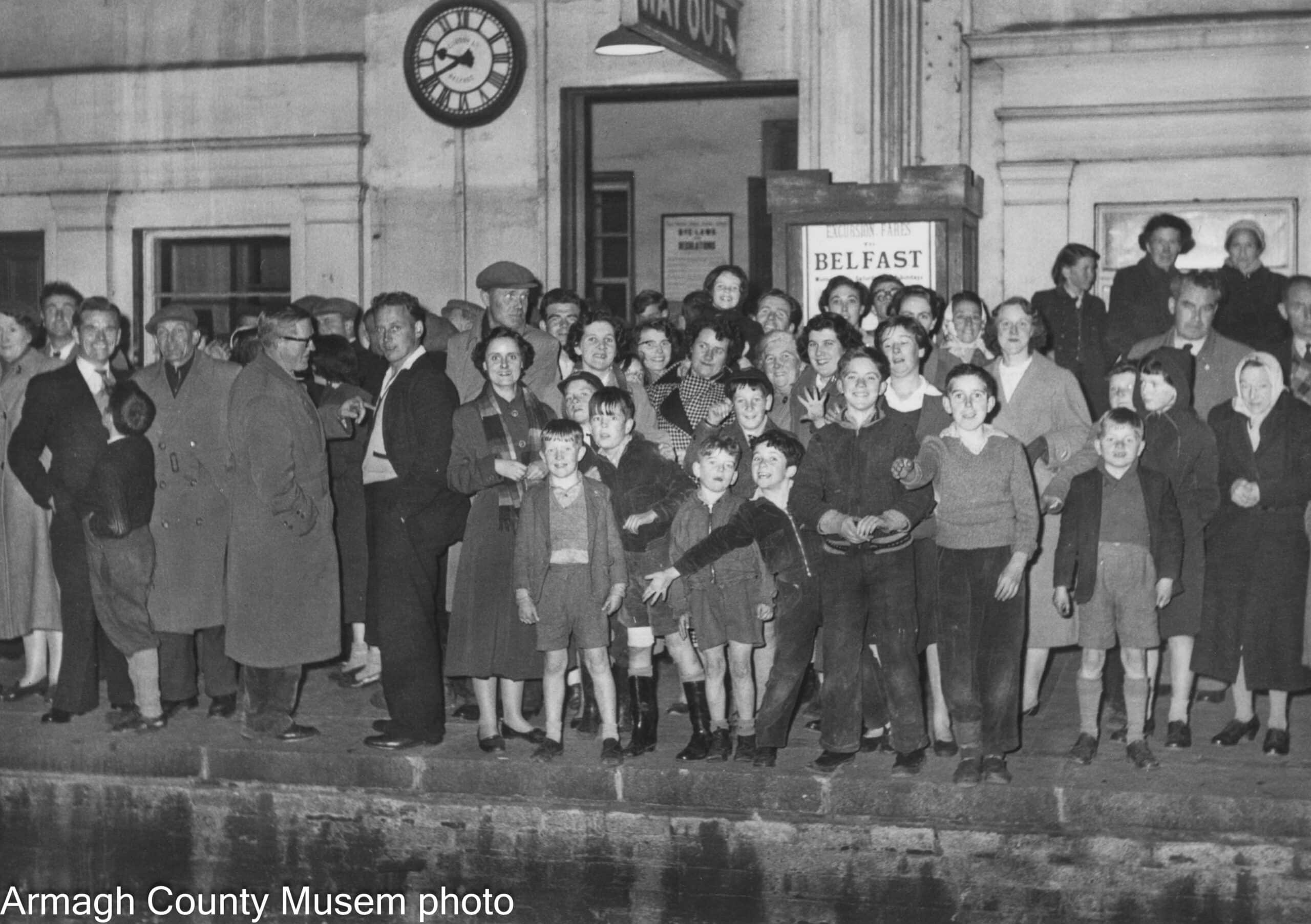
As the picture shows, young and old alike had gathered to watch as the last passenger train left the city of Armagh on the evening of Monday, September 30, 1957.
According to Mr Hutchinson, it left a “thriving city” without a rail link, a line truncated at Portadown.
This section of the Great Northern Railway, he told Armagh I, was to be dismantled, “leaving 10,000 citizens with the feeling of abandonment”.
“Of course,” he said, “these same people were to be offered a bus service, stopping at every hole in the hedge and passing along roads which hungered for upgrading and replacing. Many of the faithful railway employees were to lose their jobs or transfer to positions alien to their previous employment.
“Sixty-nine years later the Portadown to Armagh railbed lies silent. The permanent waymen who served the double track are long gone; the signals and halts have disappeared. Agriculture has crept onto the vacant spaces and farm sheds have benefited from the levelling of the navvies of the 1840s.”
Now, Mr Hutchinson adds, the all-important question is will there be a resurgence of this railway once again?
To he – and his fellow campaigners in PARS – the answer, and their vision, is an unequivocal and resounding ‘yes’.
For they believe that the city will fail to reach its full potential and instead face further decline if the status quo remains.
“Armagh City now has a residential population of 16,000 and there is an awareness of the need for better connectivity between the city and other places,” said Mr Hutchinson.
“People are more likely to commute to Belfast or further afield for well paid employment opportunities. Young students travel to Belfast and north-western universities. A modern efficient rail link would improve the lives and prospects of many, especially the 20 per cent who don’t have access to either a car or a van.
“Armagh is proud of its educational establishments and its tourist scene and would welcome a plethora of people to our wonderful city; many tourists decline to visit Armagh as there is currently no rail link.”
With the next step for Armagh-Portadown being an outline business case, it’s worth noting that, in recent times, the All-Island Strategic Rail Review identified Armagh City as a route towards Monaghan, Clones, Cavan and Mullingar, potentially opening up the centre of Ireland to rail travel once more.
“This too is under active consideration,” said the optimistic PARS chairman. “There has been a re-evaluation of transport in many regions and it is understood that rail will play a large role in the movement of people and freight in the coming decades.
“Translink have provided the modern Grand Central Station in the city of Belfast. The station boasts seven platforms. It is hoped that, in the not-too-distant future, a train will be standing at one of these platforms ready to transit to the Cathedral City of Armagh.”