There will be no public inquiry into the cervical screening scandal in the Southern Trust area.
Confirmation came from Health Minister Mike Nesbitt upon completion of an independent review.
It is now close to three years since 17,500 women in the Southern Health & Social Care Trust area received letters advising them that their cervical screening results (smear tests) were being reviewed as they may have been read incorrectly.
The letters were issued following a report by the Royal College of Pathologists (RCP), which uncovered serious failings in cervical screening carried out by the SHSCT over a 13-year period.
The failings led to delayed diagnosis and disease progression, denying ladies the opportunity for early detection and treatment of cervical cancer.
Two women from County Armagh – Lynsey Courtney from Portadown and Erin Harbinson from Tandragee – died. Both were young mothers who attended screening, received incorrect results and went on to develop and tragically die from cervical cancer.
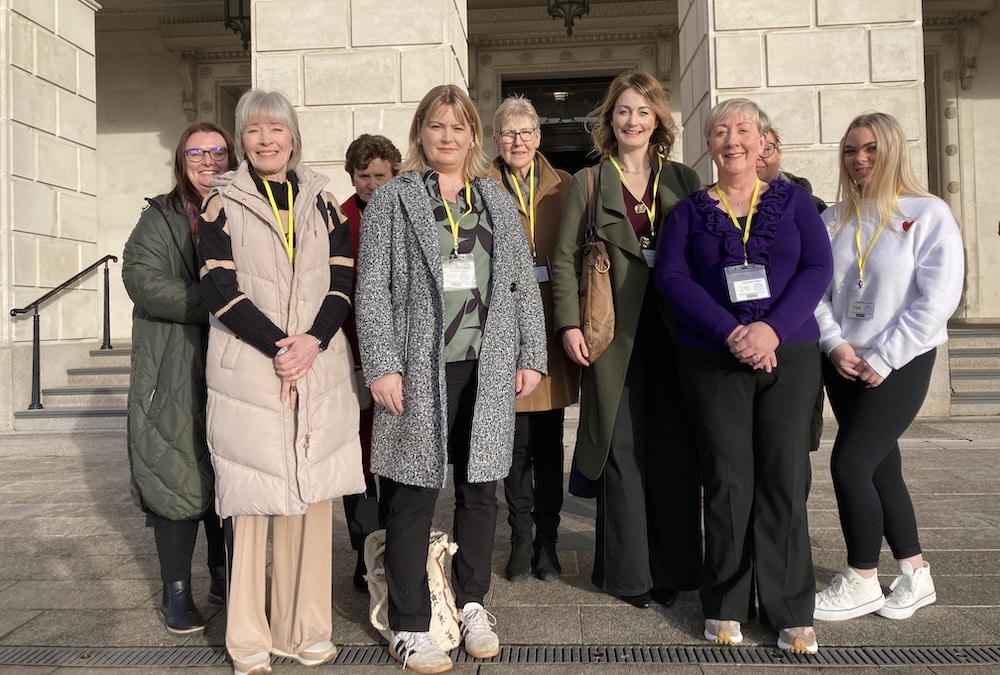
Ladies with Letters, a collective of women directly impacted by the cervical screening review, came together to campaign for transparency and demand accountability. They have been tirelessly searching for answers as to what went wrong and how a litany of failures was allowed to continue for so shockingly long.
The ladies have long campaigned for a statutory public inquiry, with other reports already having been compiled.
Minister Nesbitt, meanwhile, commissioned a further review by Professor Sir Frank Atherton, a process which Ladies with Letter had requested to be involved in.
The findings of that review have now been published this afternoon (Thursday).
And Sir Frank has expressed his opinion that a public inquiry would be “inappropriate”.
He accepted there had been “clear management and governance failings” within the Southern Trust and the Public Health Agency.
Sir Frank, in his report, wrote: “In my discussions with impacted women and their partners I heard a very clear message that, in their opinion, a public inquiry is required to assign accountability and to ensure that individuals and organisations are obliged to give truthful account of actions/failures.
“I understand these concerns as reflecting a desire for both closure and certainty. I also heard anxieties (largely from officials) that a public inquiry would be time consuming, risk re-traumatisation, further delay resolution, involve significant expense, and potentially fail to deliver any greater clarity on the nature and extent of programme failures which are documented in the commissioned reports and summarised here.
“I believe that it is highly unlikely that a statutory inquiry would be able to make further progress on unravelling the technical aspects of the programme failure which I have summarised. The inconsistencies in both programme delivery and data management which are described in the commissioned reports militate against any further clarity being shed on the questions of the degree to which the cervical screening programme may have failed women or on the quantification of any
impact.
“A statutory inquiry would, by its nature, give a greater degree of assurance on matters related to full disclosure and truthfulness of testimony by individuals and organisations. All I can say on this matter is that the authors of the commissioned reports appear to have received all the documents and data which they requested and that I did not encounter any reluctance to provide information or explanation during my inquiries (although I recognise that my discussions were with current rather
than former incumbents of key leadership roles).
“With regard to the role of a statutory inquiry in assigning accountability, it should be clear from this summary report that there have been significant failures in management and governance by the organisations which were responsible for delivery and oversight of the cervical screening programme.
“These failures have been recognised by those organisations and the challenge for them is to ensure that the many recommendations which have been made in the individual commissioned reports are implemented without delay.”
Sir Frank said the production of a consolidated action plan would be “helpful in this regard” and delivery “should be closely monitored”.
But he continued: “A statutory inquiry might attempt to assign accountability against individuals either in the front-line delivery or management of cervical screening services.
“In my view this would be inappropriate as to do so would encounter the difficulty outlined above of distinguishing between the inherent features of a screening programme (which, even when operating under optimal circumstances, will never be able to identify all cases of future disease) and a diagnostic programme (which is expected to give a more definitive
conclusion).”
It was in November that Minister Nesbitt appointed Sir Frank to conduct his independent expert review of all previous work in relation to cervical cytology services delivered by the Southern Trust between January 2008 and October 2021.
And he has now accepted that report and his recommendation in relation to a public inquiry.
Said Mr Nesbitt: “I asked Sir Frank to consider whether a statutory public inquiry might provide additional significant insight and assessment to the findings already made in relation to questions of responsibility and to the future safety of this important population screening programme.
“Sir Frank concluded that while there have been significant failings, a statutory public inquiry is highly unlikely to provide any further clarity. I accept these findings and advice from Sir Frank. A statutory public inquiry is a means to an end, that end being answering key questions. I believe those answers have been addressed as far as that is possible. We know what happened, why it happened, who was responsible and what has been done to try to ensure it never happens again.
“I recognise that this decision will be disappointing for many. I want to reassure them that lessons have been learnt and we will continue to make developments to improve our cervical screening programme in Northern Ireland.”
In his report, Sir Frank acknowledged that significant improvements have been made to the current cervical screening programme. These included the important change to screening which is now based on primary-HPV testing and the reconfiguration of laboratory services to improve oversight.
Minister Nesbitt added: “All recommendations to strengthen accountability and quality assurance arrangements have either already been fully implemented or are in the process of being implemented. I have tasked my officials to ensure that all recommendations made by Sir Frank, and from previous reports, are fully implemented.
“Screening programmes are complex by nature, which is apparent in all reports commissioned and published to date. It is also important to state that screening is not the same as a diagnostic assessment. Screening inherently is more open to false negative conclusions. Moving to HPV screening is fundamentally different to the one delivered during the period in question and designed to decrease the number of false negatives.
“I would encourage all those eligible to take up the offer of cervical screening when invited to do so. It is an extremely important screening programme which has been proven to save lives.”