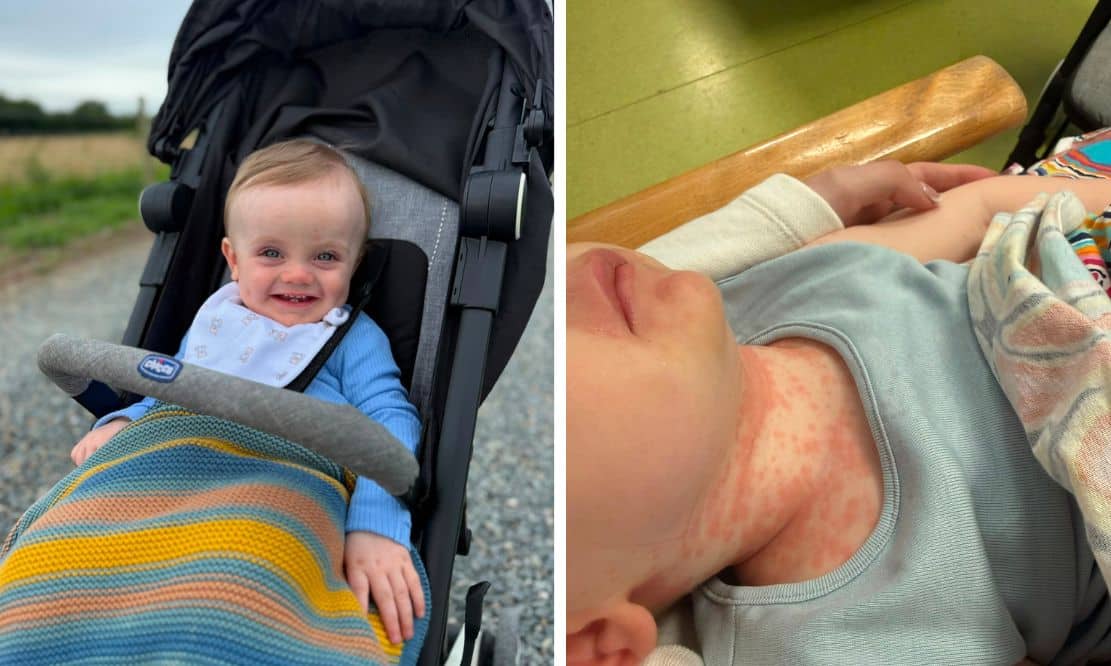
A Coalisland mum whose 11-month-old son endured ten days of listlessness, fevers and pain before being diagnosed with rare but serious inflammatory condition is sharing her story with the hopes of ensuring no other child is left waiting for answers.
Caitlin Harte reached out to Armagh I after her son, Mícheál, was diagnosed with Kawasaki disease on day ten of a crucial “ten day window” for effective treatment of the condition.
During the course of those ten days, little Mícheál was passed from pillar to post between out of hours surgeries and hospitals with various misdiagnoses being given including throat infections, Scarlet Fever and conjunctivitis.
It all started on July 12. That Sunday morning, Caitlin said he woke up with a temperature and was “irratated”.
Concerned, she said: “I took him to out of hours on the Monday. They said he had a throat infection and they gave an antibiotic. The next morning he woke up and he had a rash, red eyes and his hands and feet were all yellow.
“His temperature wouldn’t go down so I took him to Craigavon Area Hospital”. There, they admitted him.
She described a rash so red that it looked like a “kettle of boiling water had been poured over him”.
He had a swollen lymph node measuring around 4cm in his neck and his armpit glands were also swollen. The doctors there told Caitlin said he had Scarlet Fever, provided him with intensive antibiotic treatment and sent him home on the Wednesday afternoon.
She wasn’t entirely convinced. The rash with Scarlet Fever tends to feel like sandpaper to the touch and her son’s rash was flat and smooth. She also could find no information relating to red eyes or yellowing hands and feet with the infection.
Caitlin was due to collect more antibiotics from the hospital that evening and when she went back to do so, she begged them to see Mícheál again.
“He wouldn’t eat, drink, he wouldn’t laugh or smile or make any noise. He was just lying there limp,” said Caitlin.
Sadly, the hospital chose not to readmit Mícheál. He was sent home again and on Friday, Caitlin went back to the out of hours surgery.
By this stage his eyes were “blazing red”, with his rash and temperature persisting. Caitlin was told he had conjunctivitis and again he was sent home. Again, she wasn’t convinced.
Her and her husband – who had recently eloped to be married in Vegas – had booked a home wedding for friends and family on the Saturday.
They were naturally anxious about the day given their youngest child was so poorly. Mícheál stayed for the most part in a room under the watchful eye of his relatives and childminder. Eventually, sick with anxiety, Caitlin said she had to return to the room to be with him.
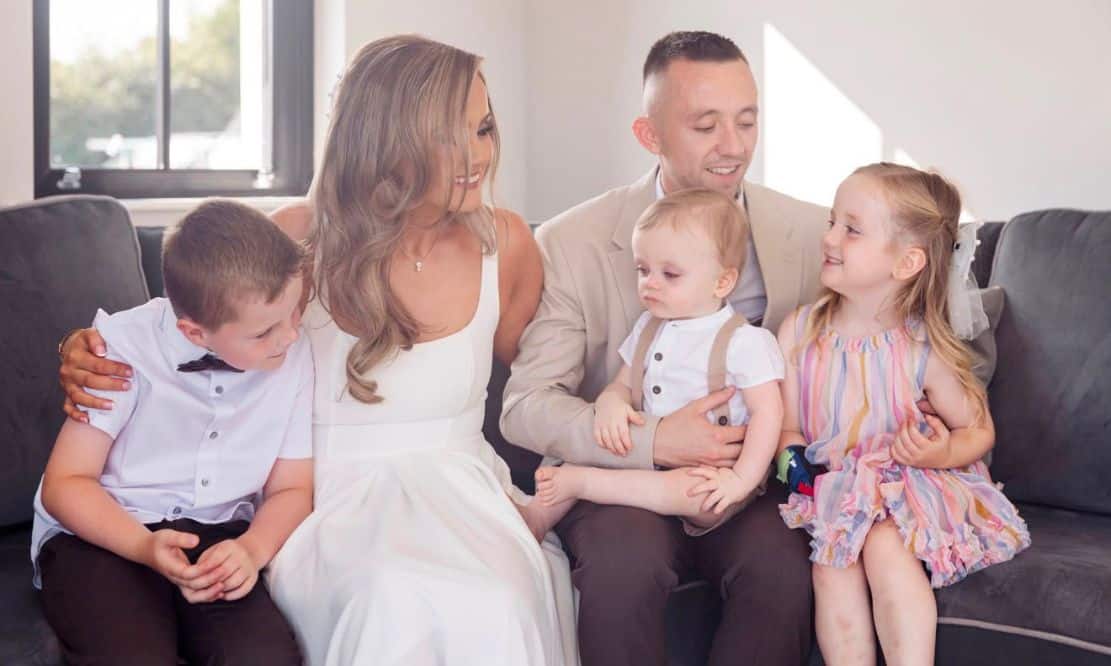
In a photo taken on their ‘home’ wedding day, it’s clear to see how ill little Mícheál was
By Monday, Caitlin was beside herself with worry. Mícheál’s temperature was persisting at a dangerous 40 degrees and none of his additional symptoms had abated.
She took him straight to the Royal Victoria Hospital, Belfast and finally… got an answer.
As soon as they saw a doctor, a diagnosis of Kawasaki disease was issued.
According to the NHS website, Kawasaki disease is a rare condition that causes the blood vessels to swell. It usually affects children under the age of five but adults can get it too. It’s not usually serious but can lead to heart problems if it’s not treated early.
There is no known cause of Kawasaki disease, and it is not contagious. There’s some evidence that it may run in families and it tends to be much more common in people from a Japanese or Korean background.
After receiving his diagnosis, Mícheál was given immediate intravenous immunoglobulin (IVIG) treatment to reduce the inflammation and help regulate his immune system.
The first therapy failed but the hospital persisted with a second, which worked. With Kawasaki disease there is a “crucial” ten day window from the initial appearance of symptoms for this treatment to be most effective. He was now at the end of that window.
While Mícheál was stabilising and his condition was now under control, regrettably, damage had been caused in the time that it took to get the appropriate course of treatment.
The inflammation had affected his heart and echocardiograms showed enlargement of both coronary arteries. He has since required intensive treatment and will need ongoing monitoring – remaining on cardiology’s radar until eight years’ of age.
During those ten nightmare days, Caitlin had recalled seeing her local SDLP Cllr, Malachy Quinn publicly raising awareness for Kawasaki disease after his daughter suffered the condition.
She Googled her son’s symptoms and, sure enough, it all seemed to fit. She raised her concerns with medical professionals prior to attending the Royal Hospital and was assured, it was “unlikely” he had it.
But as Caitlin says, “I just think as a other you know when your child isn’t presenting right”.
While, Mícheál, she says, “will get on with his life and will be fine”, she will remember those terrifying ten days forever.
And now, she’s on a mission to make other parents aware of the signs and symptoms and to encourage them to ask professionals about Kawasaki disease if they have any concerns.
Caitlin advises parents to watch out for red eyes accompanied with a fever and rash, that all come on very suddenly.
Providing a full list of his symptoms, Caitlin said Mícheál also had enlarged lymph nodes, changes to his hands and feet – including peeling skin, cracked and bleeding lips, projectile vomiting, significant inflammatory markers (CRP 148) and yellowing of his hands and feet.
Mícheál is still not back to his normal, bouncey self and it may take some weeks for him to return to his previous energy levels but, Caitlin is just so grateful to have his symptoms under control and close monitoring within hospitals going forward.
She and her entire family remain wholeheartedly grateful for the expertise and compassion of the staff in the Royal Victoria Hospital who paid such careful attention to her son while he was admitted.
Without them and their immediate intervention, she said, she “would dread to think what might have happened”.
Information relating to Kawasaki disease can be found here.
Most read today

PUBLIC NOTICE