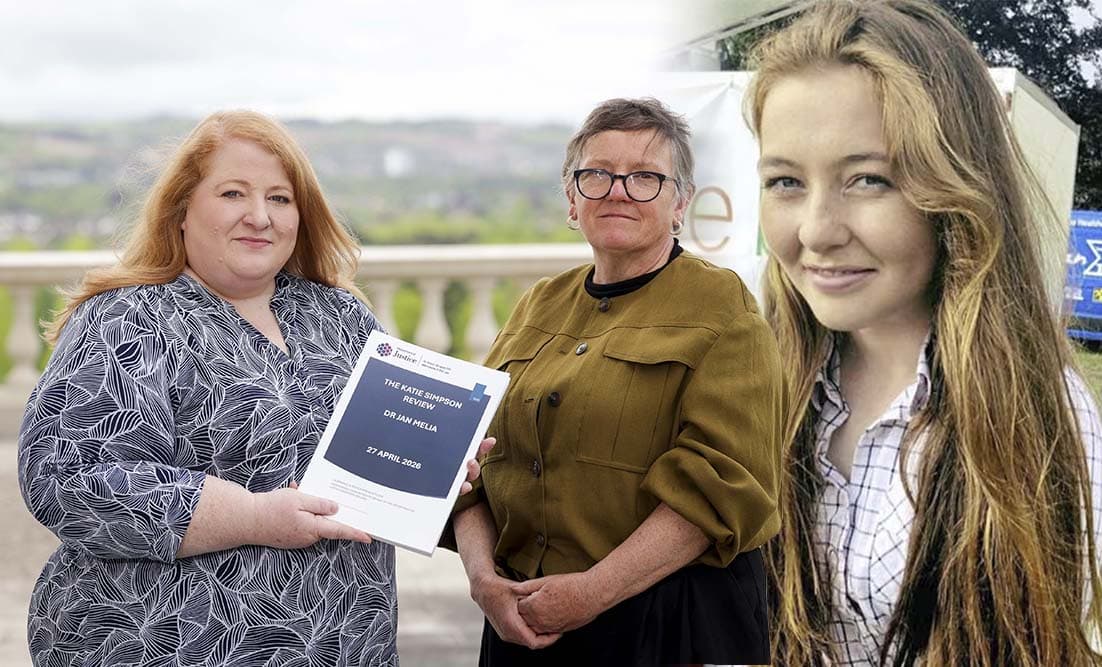
Justice Minister Naomi Long has pledged “system-wide” change in how domestic and sexual abuse is identified and tackled, following the publication of an independent review into the death of Co Armagh showjumper Katie Simpson.
Addressing the Northern Ireland Assembly on Tuesday, Ms Long said the only way to truly honour the memory of the 21-year-old, who died in August 2020, was to ensure “lessons are not simply learned, but embedded”.
Katie’s former partner, convicted abuser Jonathan Creswell, had been charged with her rape and murder. He was found dead at his home on the second day of his trial in February 2024.
Read more: Damning report details how Jonathan Creswell began grooming Katie Simpson when she was just 10
Ms Long said: “We all know the name Katie Simpson – regrettably because of her senseless, untimely and tragic death.
“We also know many individuals raised concerns about the circumstances surrounding Katie’s death and the investigation that followed. They fought to give Katie a voice; as a society, we owe them a debt of gratitude.”
The Minister commissioned the independent review – led by safeguarding specialist Dr Jan Melia – to examine what could have been done earlier to identify and manage serious offenders, and to better protect potential victims.
With the endorsement of Katie’s family, the report has been published in full.
Ms Long said it made for “uncomfortable reading”, highlighting “missed opportunities – both for Katie and the agencies that encountered her and her abuser over many years”.
“This review is not about apportioning blame,” she told MLAs. “Its fundamental purpose is to instigate collective, system-wide learning and implement change.”
The review makes 16 detailed recommendations, many of them focused on policing and the investigation into Katie’s death, which was initially treated as a suicide.
Among its key findings are:
– Serious shortcomings in how Katie’s death was investigated as a sudden death.
– A failure to properly recognise and act on patterns of coercive control.
– Weaknesses in how information was shared and risks assessed across agencies.
– Gaps in safeguarding in healthcare and in Katie’s sporting world, particularly the equestrian industry.
– The report will also help inform the ongoing Coroner’s inquest into Katie’s death.
Ms Long announced that Dr Melia will now chair and co‑ordinate an Implementation Group to oversee delivery of the review’s action plan.
“In testament to Katie’s memory and her family, we must give this Action Plan our undivided attention and without delay,” the Minister said.
“I call on the relevant agencies and organisations to fully support and co-operate with Dr Melia in this process.”
She stressed that while many of the recommendations are directed at the PSNI, “lessons from Katie’s death are not confined to the criminal justice arena and there is no hierarchy of importance”.
The Minister said Katie’s death had been “concealed and staged as suicide”, and the review made it “abundantly clear that investigative practices and mindsets must change”.
Key policing reforms recommended include:
– Recognising coercive control as a lethal risk factor: Risk assessments in abuse cases must focus on “patterns of behaviour, not isolated incidents”.
– New indicators of concealed homicide: Six specific red flags are to be embedded across all sudden death investigations and specialist training.
– Mandatory trauma‑informed, victim‑centred investigations: Sudden death and suspected suicide cases should include comprehensive victim profiling to ensure key information is not missed.
– Challenging bias and victim-blaming: Officers are to be trained to recognise and challenge gendered stereotypes, cognitive bias and confirmation bias which, Ms Long said, “empower perpetrators such as Jonathan Creswell”.
– Improved forensic standards: Forensic protocols in sudden or unexplained deaths should require pathologists to consider coercive control and staged suicide as part of their analysis.
– Early domestic abuse expertise: Specialist Domestic Abuse Officers must be involved “from day one wherever there is any history of violence within the family”.
– Clear case ownership: The review found Katie’s investigation was passed between departments without a designated lead, causing confusion and delays. Ms Long said team co‑ordination and ownership “must also improve”.
The report also raises concerns around bail and risk management of high‑risk offenders.
Ms Long said that in cases involving allegations of violence, coercive control or intimate partner abuse, bail conditions must put victim safety “front and centre”.
While decisions rest with police and the courts, she “implored” decision-makers to incorporate coercive control risk indicators into bail decisions, and ensure consultation with victims and their families where appropriate.
Within the Public Protection Arrangements Northern Ireland (PPANI), the review recommends recognising coercive control as an ongoing risk “even in the absence of a current relationship”, to avoid dangerous gaps when abusive relationships end.
The Minister stressed that Katie’s case also highlighted failings beyond policing.
A key recommendation is that all emergency department attendances involving physical injury should trigger safeguarding consideration, especially where domestic abuse is suspected or where there are multiple presentations.
She described this as “critical learning” at a time when hospital services are under severe pressure.
The equestrian world – central to Katie’s life and career – is also singled out.
The review calls for mandatory safeguarding policies, training and vetting across all equestrian facilities, including unaffiliated stables.
“It is of great concern to me that as I stand in this chamber today, there may be other young girls or women unknowingly vulnerable or already subject to predatory and secretive abuse,” Ms Long said.
One of the “fundamental” recommendations, the Minister said, is to expand Northern Ireland‑wide campaigns on coercive control to explicitly include its links to suicide and homicide.
“It is absolutely imperative that we educate all of our citizens on what coercive control is, in all its forms and potency,” she told MLAs.
Avoiding difficult conversations about abuse, she warned, “does not protect victims, it entrenches harm”.
Anticipating that publication of the report could be distressing, especially for victims and survivors of abuse, Ms Long said her department had proactively engaged with support services to prepare for an increase in requests for help.
She urged anyone who recognises elements of their own lives in the report to “take that first step and reach out to someone you can trust”.
“If you do not have that trusted person, then please make contact with professional services and organisations,” she said, adding that anyone in immediate danger should contact the PSNI without delay.
The Minister said implementing the review’s recommendations would be a significant task, but would be underpinned by existing Executive strategies, including:
– The Domestic and Sexual Abuse Strategy 2024–2031, led by the Department of Justice and Department of Health, which already contains 56 actions in its initial three‑year plan.
– The Executive’s ‘Ending Violence Against Women and Girls’ strategy, now in its second delivery phase.
“Both these strategies quite rightly demand this Executive works collaboratively and tenaciously to deliver on these many commitments,” she said.
“We must do so in Katie’s memory. We must do so in memory of all victims before and after Katie’s death. We must do so, to reduce harm and save lives.”