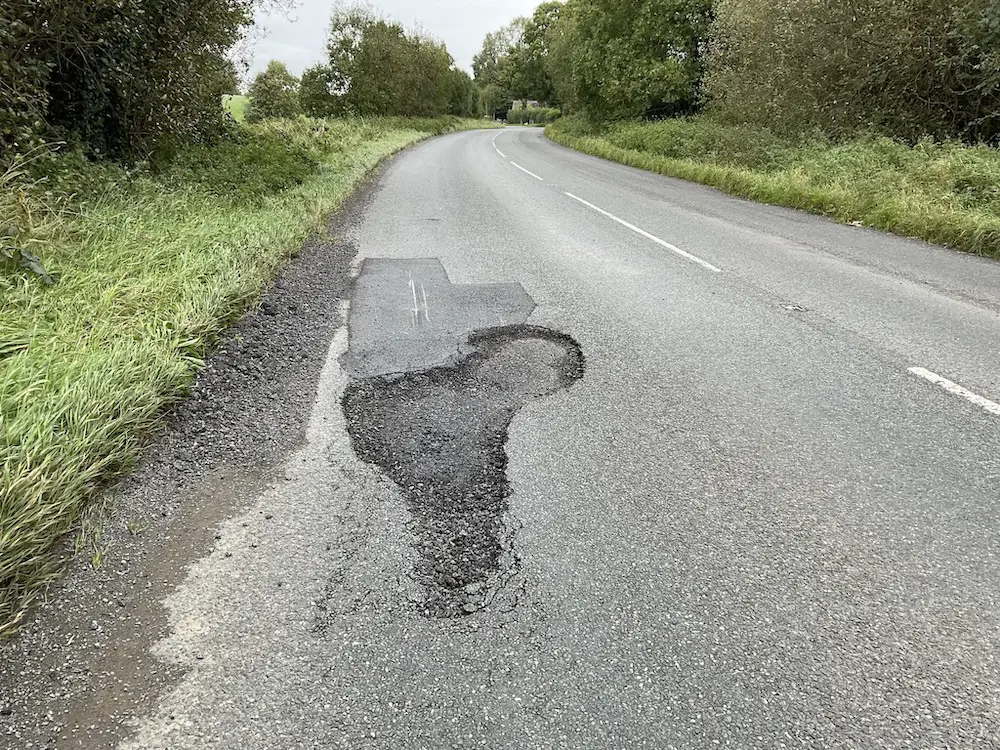
Roads Minister Liz Kimmins has been accused of “bad management” after confirmation that an eye-watering £7,000 in compensation was paid out for damage to a single vehicle which struck a pothole that had been left unrepaired for so long.
TUV Councillor Keith Ratcliffe pulled no punches when DfI Roads officials came before ABC Council this week to present their annual report.
The local councillor said he was “extremely concerned” about “basic infrastructure of our roads”, describing figures from the Northern Ireland Executive as “extremely grim reading”.
Since 2021, Councillor Ratcliffe said claims in the Department had shot up from 237 to 1,687 – an increase of 600 per cent!
The £7,000 repair bill paid to a motorist for damage caused to their vehicle was part of the overall total compensation claims which was approaching £1 million a year.
“That is scandalous,” said Councillor Ratcliffe. “This is our basic infrastructure and it’s time the Minister got her act together. Liz Kimmins is the Infrastructure Minister and this is bad management, absolutely bad management, and we have to have accountability whenever there’s failings like this.”
The TUV representative asked Southern Divisional Roads Manager Cindy Noble if she envisaged the number of potholes locally reducing in the next year and how they were going to deliver that.
And he added: “Every single year we have been coming in here, the number has been rising year after year after year and for a 600% rise is absolutely unbelievable.”
Ms Noble conceded they had witnessed an increase in the number of defects being reported on the roads network over the past year.
But she added: “We have, for over 10 years now, since 2015, been operating our limited service, which has only allowed us to focus on those higher priority defects. So, unfortunately, that’s why we see an increasing number of defects on the network.”
She said a number of reports had highlighted under-funding and a deficit within structural maintenance.
Looking ahead, however, Ms Noble explained: “One of the things that the Minister has launched this year and we will be taking forward is the new road maintenance strategy. That will see hopefully a more focussed, more targeted intervention, and not just focussing on potholes when they have occurred but trying to deliver best value and target the investment in our roads before the roads have deteriorated, so that’s one of the initiatives that we’re working on.”
She said a digital survey of all of the road network – 26,000 kilometres for Northern Ireland, just over 8,000 kilometres in the Southern Division – had now been completed and the various roads divisions would be looking at that and “trying to see how we can deliver best value and trying to get more targeted intervention across the whole of the network”.
“It’s not always going to be about treating the potholes,” added the Divisional Manager. “It’s trying to invest in the network. It is a valuable asset – one of the most valuable that we have within Northern Ireland – and hopefully we can try and continue to deliver the maintenance of it, but it’s a mammoth exercise for us.”
Earlier in the course of her presentations, Ms Noble confirmed there had been in the region of 82,000 ‘incident’ reports logged through its public information portal in the past year, about half of them relating to street lighting and the remainder concerning other roads matters.
It was, on her own admission, “a hell of a lot”.
Presenting the annual report, Ms Noble had said the road network was Northern Ireland’s “largest and most valuable public infrastructure asset”, valued at approximately £37 billion.
She added: “It plays a vital role in supporting our communities, economy and daily lives. While much has been achieved, we recognise the ongoing need to protect, maintain and enhance this important asset.
“To support this initiative, the Department has published a new road maintenance strategy, introducing a more modern evidence-based approach to network maintenance. The strategy is intended to improve maintenance standards, target resources more effectively, deliver higher quality and longer lasting repairs, and ensure investment is directed to where it is most needed.”
Turning to budgets, while not yet formally agreed by the Executive, there had been an “indicative allocation” of approximately £98 million identified for structural maintenance, which represented an increase of around £30 million compared with the opening allocation last year.
Included within this funding was £12.5 million for a roads recovery fund to support priority resurfacing, roadside stability and drainage improvement schemes.
Over the past year, the Roads Manager said schemes were successfully completed on the Moy Road, Armagh, and the Derrymacash Road. Further resurfacing schemes are planned this year on the Coolmillish Road at Markethill, and Princess Way in Portadown.
Said Ms Noble: “The Department remains focussed on maintaining public safety, protecting the transport network and addressing regional imbalance. Additional investment is being directed towards priority maintenance activities, including improvements to road signs, road markings and patch repairs.
“However, the Department continues to operate within a constrained resource budget, and as a result, the limited service policy will remain in place for routine maintenance activities, such as defect repairs, grass cutting and gully emptying.
“Grass cutting will continue to focus on safety critical locations with visibility displays on heavy traffic routes cut at least twice per year, and once annually elsewhere, where it is safe to do so.
“This approach seeks to balance road safety improvements with environmental considerations and biodiversity objectives. Additional resources have also been allocated to improve patching programmes, drainage maintenance, signage repairs and road marking renewals.”