Long days but never a dull moment and not a single worry… that’s how one of Armagh’s most well known former market stall owners recalls his 40 years of hard – but rewarding – graft.
For half his lifetime, Harry McKennell – now approaching 90 years of age – was a familiar face to many market-goers across Armagh, Dungannon, Portadown, Cookstown and Strabane.
He wore many hats. First, a Steriliser Operator at Tullygoonigan Factory, then a relief bread man travelling as far as Newtownards, before eventually getting into vegetables and flowers locally.
Harry can sew a story just as well as a seed. Sharp as a tack, he can recall with fervour and flair the most minute details of how he entered into the market trade all those years ago, almost as though it happened just this morning.
Armagh I visited Harry at his Loughgall Road home for a little look back to the bygone days of the door-to-door milk and bread men, of ‘old money’ and elbow grease.
Upon opening his front door, this reporter was tickled to be greeted by a bright-eyed Harry, clad in a pair of work-style overalls akin to dungarees over a red and white checked shirt, topped with a navy blazer. If one didn’t know any better, they’d assume he was ready to be whisked away for a busy day on the stall!
While those days of hard toil are behind him, Harry was ready… ready to reminisce.
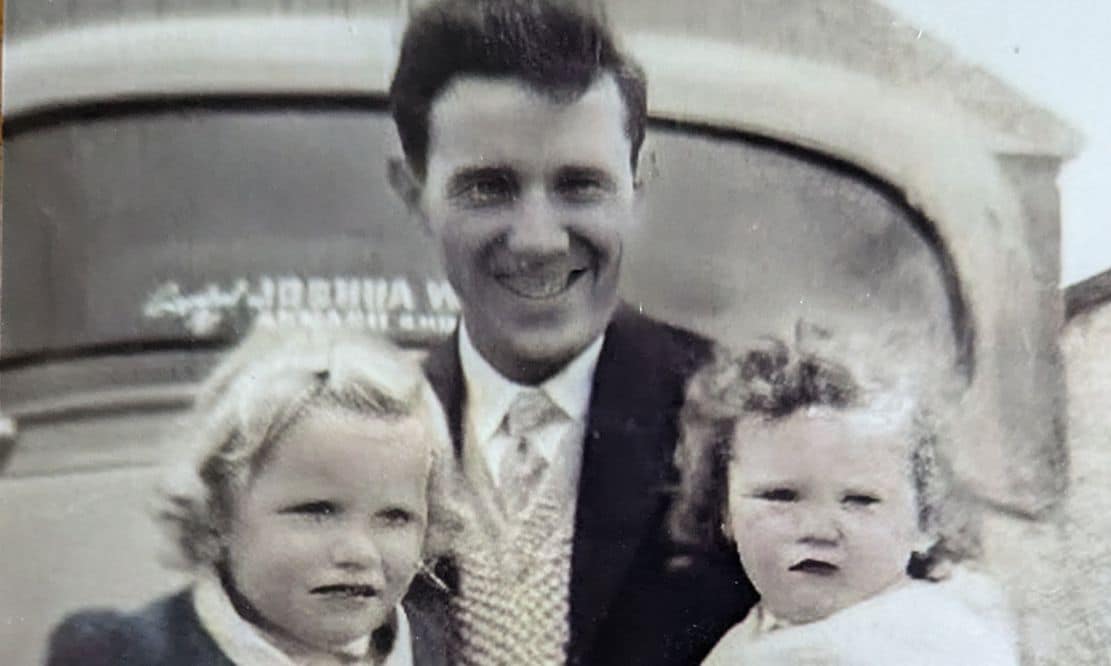
He had carefully laid out a collection of old family photos on the living room coffee table. Some colour, some sepia and, others, black and white. Without words, they told a story too. But Harry was more than happy to fill in the blanks.
Starting where all good story tellers start, Harry went back to the beginning to the days he spent working at Tullygoonigan Factory.
“I had a very responsible job… a very, very responsible job and all the money I got extra for it every week was 12 shillings, that’s 60 pence,” he said. “When I started, what do you think my pay was? It was less than a pound an hour. I worked there for a number of years and my pay rose every year. When I left, my pay was eight pounds, eight shillings and four pence a week. When I started first my pay was less than five pounds a week.”
Harry worked as a Steriliser Operator at the factory while also growing and tending crops on the home farm in his “spare” time.
Explaining his role, he said: “What they did was, they bought in all the milk from tankers and then they put it in tins. They had a machine for filling them and it filled them 12 at a time and pushed out 12 more. It was fast. They went through 126 tins per minute. Then you had to sterilise the milk in the tins. They put the lids on them and they rolled down a line to a washer and then into the steriliser. I had to turn and control the steam to 243 degrees of heat.”
Back then, Harry was still living with his parents. As he was working on the farm – where they grew potatoes and barley among other crops – he didn’t need to “pay into the house”. He squirrelled away what he could of that meagre pay. And just as well he did, for he soon met the love of his life and his future wife, Hannah, who also worked at the factory.
Once they were married, they would need somewhere to live as husband and wife. A colleague gave him the head’s up on a farmhouse near Hamiltonsbawn with two acres of land. Harry said he “put one bid on the house and I got it”. Their matrimonial home came at the cost of £750, which Harry had saved.
Shortly after moving into their home Harry began to work as a relief bread man.
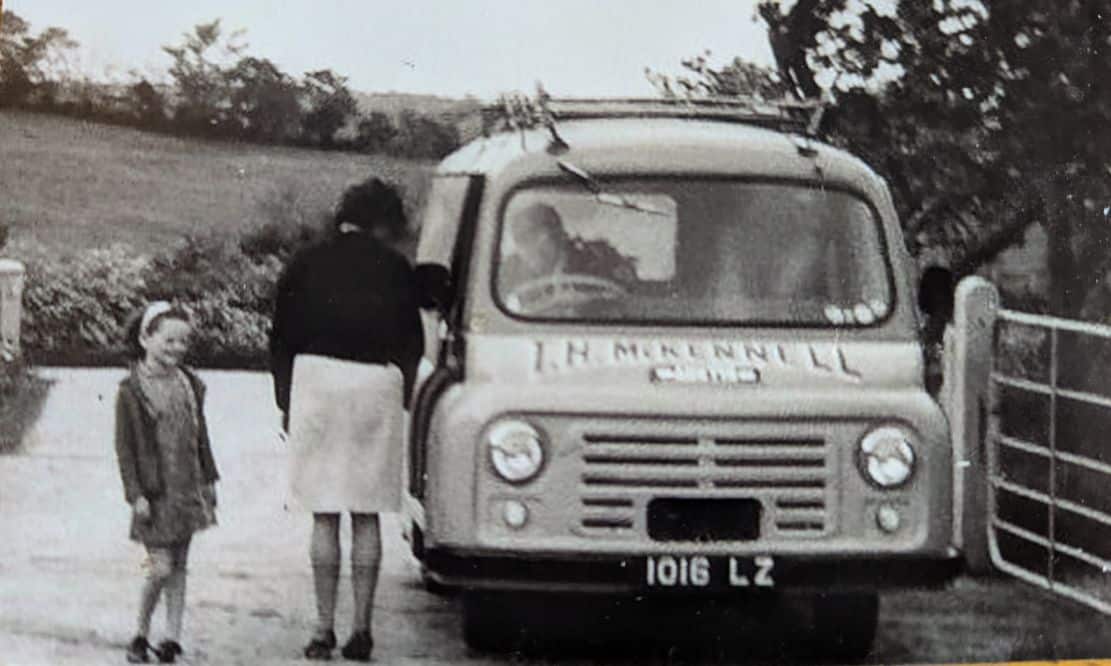
Harry’s first ever van for transporting his wares to market
He said: “When the local bread man was off sick somebody had to stand in and do his run. I was in five of the six counties. Those were long days. I was away in Newtownards and you had to be there early in the morning.
“Some of them bread men had a big, big run maybe 100 houses and another man maybe would have had the half of that. The more of a run they had the more money they had, they were selling more.
“When there was a big run I had to do it. One place was very hard to please the people, that was Portadown. That was because they had the bakery in Portadown.”
He recalls the price of two loaves of bread back then to have been around 11 pence in today’s money, two shillings.
While he enjoyed those days, he admits, they were long. It was early starts and late finishes. Plus, the work was never a guarantee.
The green-fingered Harry never stopped growing. He was always planting, always adding onto his home house with outhouses and “glass houses”.
Aged 21, he remembers going into a “seed shop” on the Shambles… that, he says, is where the real story starts.
“I went in one day when there was snow on the ground and I bought a packet of lettuce seeds,” he said. “I remember it was half a crown, about 12-and-a-half pence in today’s money. I went home with my packet of lettuce seed and there were old boards laying about so I made a box.
“We had an orchard and the apple trees would have been 100 years of age and they were done. My father pulled them out and this was good, black, rich soil. I took the grape and started to dig up rigs down the garden. I dug a hole in the ground and put the box on top of it and pushed an oil heater underneath the box and sowed the seed in the box and covered it all over with old bags.
“I kept an eye on the lettuce to see and it started to come up. Then when I took the bags off, I put a bit of glass on top. You were heading into March / April then and I had all the rigs ready. I transplanted the lettuce out. It was a good crop.”
Around this time, Harry’s father had bought their first ever family car. It was before the time of driving licences and Harry had learned the ropes himself.
He cut up a few of the lettuces – of which he said some of the leaves were “as big as your hand” – put them in a box and drove himself to The Garden Stores, in Armagh city then run by a Mrs Flanagan.
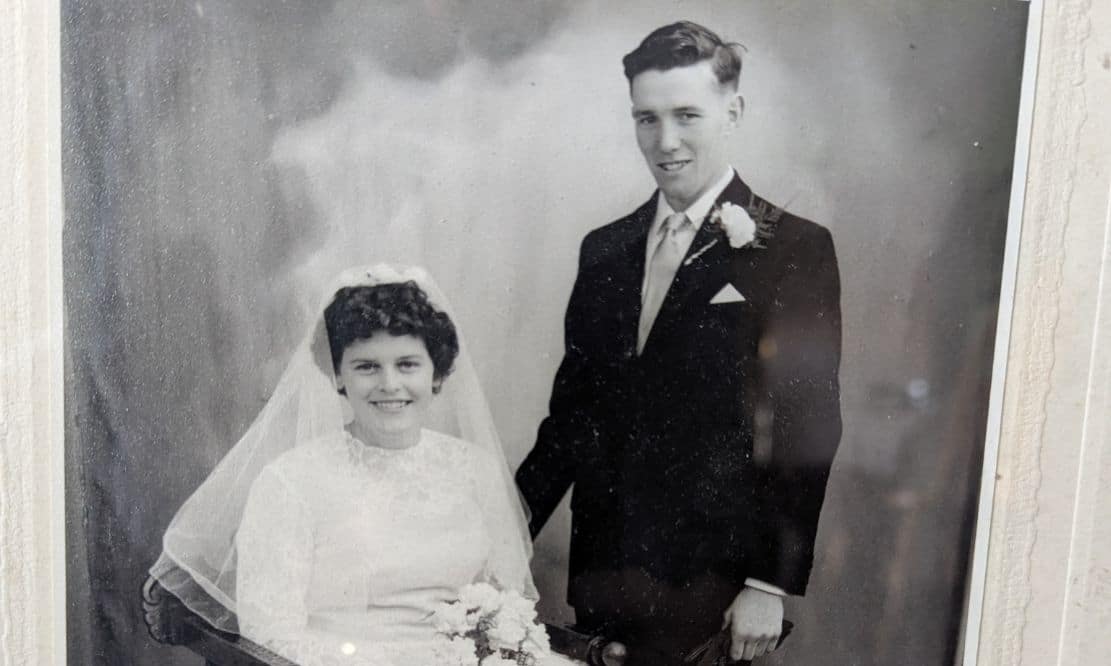
Harry and his wife, Hannah on their wedding day
“I went in with this box of lettuce to show her,” he continued. “She was surprised at the size of them so early in the year. She said, ‘Have you many of them?’ I had them counted… 960 I had out of that packet of seed. Then she said, ‘How much do you want for them?’ I wasn’t up on the price of lettuce but I said, four pence each.
“That was 60 lettuce for a pound. That’s old money, things were different. She opened the till and handed me £16 into my hand, well, that was three weeks’ wages.”
That day, he said, really “started me off with flowers and vegetables”.
Later, he sort of fell into work with a nursery owner by the name of Ben Simpson. Ben owned the Hamiltonsbawn Road nursery and ran stalls at local markets selling his wares.
“I went in one day to get tomato plants for my glass house. He said, ‘You’re too early’. They weren’t ready. Then he said, ‘Do you know anyone would do the markets for me?’ I started to enquire what they pay was and all. The more you sold, the more you got. That was the way it worked, so I said I would take on the job.
“All the money I got in the market, he got it. There were other men who would have sat all day in the pub drinking it,” laughed Harry.
Despite taking an “awful amount of money” on Ben’s stalls on occasion, Harry always handed the full amount to Ben at the end of the day. They had a solid relationship built on mutual trust.
Soon, he caught the bug and began thinking “I could do this for myself”. When another stall owner – who attended the Armagh and Dungannon markets – retried, Harry saw an opening. He applied for a stall-holders licence with both councils… and was accepted.
The next question was obvious. What did Ben say?
“Well, I went to Ben and said ‘I’m leaving'”, said Harry. “He said, ‘What are you going to do?’ and I told him ‘I’m going to have a go at this on my own’. I didn’t tell him I had the licence but I told him I would buy a bit of stuff off him to get a good variety of stuff for the market. I worked a week’s notice and then went back to buy stuff from Ben and he said, ‘There’s not much point selling against myself’!”
Harry laughed as he thought back to that day. Perhaps he should have seen it coming. But he had stock of his own from his home place and managed to get that “variety” he wanted from Davidson’s nursery instead, who he said “would have sold me the place!”
Several years later, Harry managed to acquire his uncle’s fifty acre farm in an area off the Cathedral Road known as Tyra, correctly pronounced ‘T-raw’ he said.
His uncle had it valued by a man of the name, Jack Cairns. He placed a price tag on the estate of £7,000. Harry said candidly, “If he had of told me it was valued at £7,500 I wouldn’t have taken it. That was big money back then.”
But he did take it at what he regarded a fair price. He sold his Hamiltonsbawn home and scraped together savings from the markets. He still came up slightly short but was granted time to “pay what I owed without interest”. In three years, he settled the debt.
“I put up the glass houses then,” he said. “There could be an acre-and-a-half of glass at least… and more. Then I went into the flowers. I sold the flowers in Rathfriland, Dungannon, Strabane, Armagh, Cookstown on market days.”
To this day, Harry’s son David continues that family business. He now looks after the “glass houses” that Harry installed during the height of his market days and is still a familiar sight at Armagh market, in The Shambles.
In today’s climate, Harry can’t quite get to grips with the price of land and property. Nor can he fathom inheritance tax.
He’s incredibly proud of his children Roberta and David, who he speaks of with such fondness. Not one of their photos from the coffee table was passed without mention.
His wife Hannah, who he described as a “constant worker”, was by his side throughout it all. Their wedding photo takes up pride of place on the hearth.
When reviewing the photos he laid out, every one was mentioned; his parents, uncles, aunts and even neighbours.
While his story was focused on his work life, they are the reason he worked.
Most read today


PUBLIC NOTICE