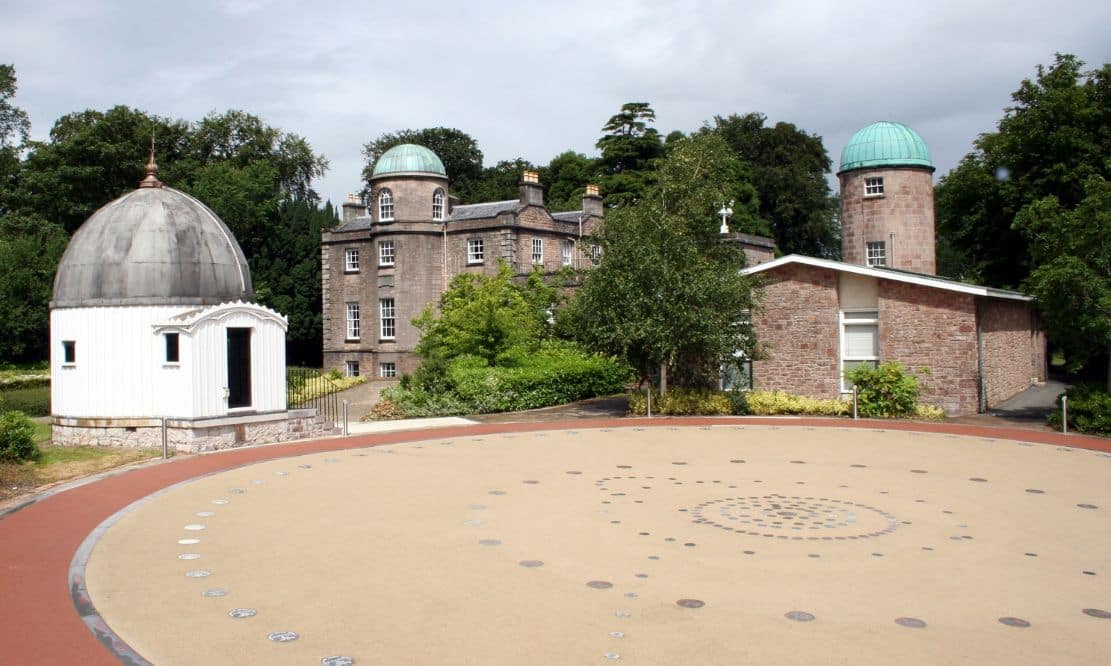
The team at Armagh Observatory and Planetarium (AOP) are preparing for one of nature’s most spectacular celestial events, the likes of which won’t be seen again for more than 50 years.
Taking place on Wednesday, August 12, the Moon will cover approximately 94% of the Sun, causing a partial solar eclipse.
It will be the deepest eclipse seen from the region since the total eclipse of August 1999 and the last time that such an eclipse will be seen here until 2090.
Director of Armagh Observatory and Planetarium, Professor Michael Burton said this partial eclipse is one of the most eagerly awaited for decades.
He said: “While we won’t encounter totality here – only a narrow path across Greenland, Iceland and northern Spain will be fortunate enough to encounter this – a 94% partial eclipse is an extraordinary sight in its own right.
“At its peak, the Sun will be reduced to the thinnest sliver of light, low over the western horizon. It is going to be a beautiful and quite eerie spectacle.”
The eclipse will begin at approximately 6.10pm, reaching its maximum at around 7.08pm and concluding shortly after 8pm.
Because the event unfolds as the Sun sinks towards the horizon, observers can expect a striking scene, with the crescent Sun glowing low in the evening sky. It follows the partial eclipse of March 2025, which saw around 40% of the Sun obscured. This year’s event dwarfs that by comparison.
“The last time skies over Ireland darkened to this extent was in 1999. On that occasion people travelled from all over to stand under the path of totality in Cornwall,” Professor Burton said.
“You don’t need to travel anywhere this time – history is coming to us.”
To mark the occasion, Armagh Observatory and Planetarium host a day full of family-friendly activities from 10am to 8pm, including hands-on science demonstrations, dome shows and eclipse-themed events for all ages.
“We want this to be a day the whole family remembers,” added Professor Burton.
“Visitors will be able to learn about the science of eclipses, discover how astronomers safely observe the Sun, and enjoy a programme of activities suitable for all ages before joining us outside as the real thing unfolds.”
As eclipse time approaches, the AOP team will be on hand throughout the afternoon and evening to provide safe solar viewing opportunities and answer questions about the eclipse and the wider universe.
Professor Burton was clear on one point above all others – never look directly at the Sun, even during a partial eclipse.
“The Sun is never safe to look at directly with the naked eye, binoculars or a camera, no matter how much of it is covered by the Moon,” he said.
“Sunlight contains strong and harmful ultraviolet (UV) light which will damage your eyes. Use eclipse glasses, solar filters, or make a pinhole projector using a cardboard box, tin foil and white paper.”
Hopes are high for good weather at Armagh, but Professor Burton said the event will be worth attending regardless of conditions on the day.
“Clear skies or cloudy, the eclipse gives us a wonderful reason to come together and think about our place in the cosmos.”
For more information, click here to visit armagh.space