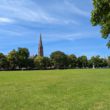
Evidence from forensic experts on the second day of an inquest into the deaths of four young Armagh people has pointed to “speed-related loss of control” as the car attempted to take a bend before colliding with a tree and bursting into flames.
The hearing at Banbridge Courthouse is examining the circumstances of the crash on the Ballynahonemore Road in the early hours of Sunday, March 24, 2024, in which Philip Mitchell (27), Keith Morrison (22), Emma Mallon (22) and 24-year-old mother-of-one, Marina Crilly, all lost their lives.
On Monday, the opening day of the inquest, the court heard harrowing accounts from first responders and passers-by who tried desperately to pull occupants from the burning Volkswagen Golf and give CPR, as well as moving tributes from the victims’ families.
Tuesday’s evidence focused on collision reconstruction and the speed of the car in the lead-up to impact.
Ryan Young, a senior scientific officer with Forensic Science Northern Ireland’s road traffic collision unit, told the court he attended the scene a few hours after the crash.
He said the Golf had suffered “substantial frontal damage, concentrated centrally” after striking a large mature oak tree, and that any subsequent fire damage had been “extensive and catastrophic”.
However, despite the level of destruction, his examination found no evidence that a mechanical problem had caused the crash.
“There were no indications of any pre-collision defects in the braking, steering or suspension which could have contributed to the collision,” he said, adding that components which remained intact were in “serviceable condition”.
Mr Young described the Ballynahonemore Road as a rural, unlit right-hand bend on a slight incline.
“When I arrived, it was dry, but the surface was damp,” he said. “In my opinion, the road was in fair condition. There were no contaminants or irregularities present which could have contributed to the cause of the collision.
“Direct tests at the scene indicated that the level of grip on the road surface was satisfactory, even in damp conditions.”
From the burned-out seatbelt hardware, he said there was evidence the driver and front-seat passenger had likely been belted, although he could not say whether the rear occupants were wearing seatbelts due to the damage.
A significant portion of Mr Young’s evidence centred on CCTV gathered from several locations as the Golf travelled out of Armagh in the direction of the crash site.
He told Coroner’s counsel Michael Boyd he had reviewed footage from cameras at the Mall West area, the PSNI’s Gough Barracks, a private address at Bannvale Mews and a commercial premises referred to as Tretzo.
Across those clips, he said, a vehicle matching the collision car by type, colour and partial registration could be tracked leaving Armagh city centre and heading towards Ballynahonemore Road.
Using measured distances between fixed points in camera views and the frame rate of the footage, Mr Young calculated the Golf’s speed at various locations.
At Gough Barracks, during an overtaking manoeuvre in a 30mph zone, the car covered 50.7 metres in just over two seconds, an average of around 55mph. Allowing for timing tolerances, he gave a range of 53–57mph.
At a second city location, he used an unrelated blue car travelling at around 20mph as a reference vehicle. By comparing how much quicker the Golf traversed the same camera view, he concluded it was moving between 2.5 and 2.9 times faster – equating to roughly 50–58mph, again in a 30mph residential area.
Further out at Bannvale Mews, approximately 1.3km from the crash scene, he said the Golf covered a measured 244.1 metres in about nine seconds, producing an average speed of around 61mph, within a possible range of 56–67mph.
At a later point, near Tretzo, speed appeared to reduce to around the mid‑40s mph, but Mr Young stressed that, taken as a whole, the footage illustrated “a pattern of speed higher than the speed limit” as the car travelled through built‑up areas on the way out of Armagh.
Turning to physical markings at the scene, Mr Young explained in layman’s terms how the forces on a car change when it takes a bend too fast.
As a vehicle negotiates a right-hand bend, he said, it experiences an outward “centrifugal force” pushing it leftwards; if that force exceeds the grip available at the tyres, the car will begin to slide sideways and “yaw”, or rotate, while still moving forward.
At Ballynahonemore Road, he said, two parallel tyre tracks on the approach to the tree initially showed a curved path, consistent with the car starting to “understeer” – in other words, the front tyres no longer able to steer the vehicle along the intended line through the corner.
As the marks progressed closer to the impact point, their appearance and alignment changed.
Near the nearside kerb, Mr Young pointed out fresh stone “pull‑outs”, alloy smearing and tyre marks on the top of the kerb, indicating the rear nearside wheel had clipped the kerb as the car slid sideways. Further along, the tracks straightened into two roughly parallel dark streaks, with scuffing and horizontal scrape marks.
In his opinion, that change suggested the driver had attempted to brake while already at the limit of grip, causing the front tyres – responsible for steering – to saturate and lose virtually all directional control.
“Once the vehicle had exceeded the level of grip available to negotiate the bend, the driver’s evasive actions could not recover it,” he said. “The car effectively travelled in a straight line tangential to the curve, ultimately colliding with the tree.”
By comparing the Golf’s damage to crash‑test data for similar impacts with rigid objects such as trees or poles, Mr Young estimated the impact speed to have been “in the region of 50 to 60 miles per hour”.
Allowing for the fact that the car would have been decelerating from the point the tyre marks began to the moment of impact – a distance of around 24 metres – he considered a range of likely overall deceleration rates and calculated the speed at the start of the marks to be between 52 and 67mph.
He told the coroner that, based on the evidence of braking and sliding, “it is probably more towards around 60mph at the initial loss of control”.
Asked directly by Mr Boyd if the mark pattern suggested the driver had tried to steer deliberately towards the tree, he was clear: “No. The marks are consistent with attempts to correct the course of the vehicle, not with a deliberate steering towards the tree.”
When the coroner asked whether this was ultimately “indicative of the driver and the speed being too fast” for the bend, Mr Young replied: “Yes, that’s correct.”
The inquest also heard from independent collision investigator and consulting forensic engineer, Colin Glynn, who was instructed by the family of Emma Mallon.
Mr Glynn, who holds master’s degrees in mechanical engineering and has published extensively in the field of forensic collision analysis, visited the scene in December 2025 and carried out his own survey.
He told the court he agreed with Mr Young that there was nothing about the Golf’s mechanical condition to explain the crash, and that his overall conclusion was that this was “a speed-related loss of control while the driver was attempting to negotiate the bend”.
He measured the geometry of the right-hand bend and the vertical “crest” on the approach, concluding that, in purely physical terms, the maximum theoretical speed at which the bend could be safely negotiated on a damp surface was around 63mph once the crest effect was taken into account.
Using the tyre marks recorded at the scene, he reconstructed the path of the car’s centre of gravity and calculated a travel speed of approximately 64mph at the point those marks were made – broadly in line with Mr Young’s upper estimates.
From a “technical perspective”, he said, the pattern of marks – including evidence of the car rotating and attempts to steer – showed the driver was trying to keep the vehicle on the road and follow the curve.
Asked specifically whether he had seen anything to suggest a deliberate act, Mr Glynn replied that the evidence indicated the opposite.
“It was an attempt to maintain it on the road surface, at or over its limit of grip,” he said. “The evidence suggested that the driver was trying to correct the path of the vehicle and negotiate the bend safely.”
While there were some technical differences in the terminology used by the two experts – particularly around the precise use of the word “understeer” – both agreed that all four tyres had effectively reached the limit of their grip and that the car was travelling too fast for the bend in the conditions.
At the end of Tuesday’s hearing, Coroner Anne Louise Toal acknowledged that the technical evidence, and repeated references to the final moments before impact, would have been extremely difficult for the families to listen to.
She indicated that more witnesses – including further expert and agency evidence – will be heard on Wednesday, with the inquest also scheduled to sit again on Friday morning.
Most read today

PUBLIC NOTICE