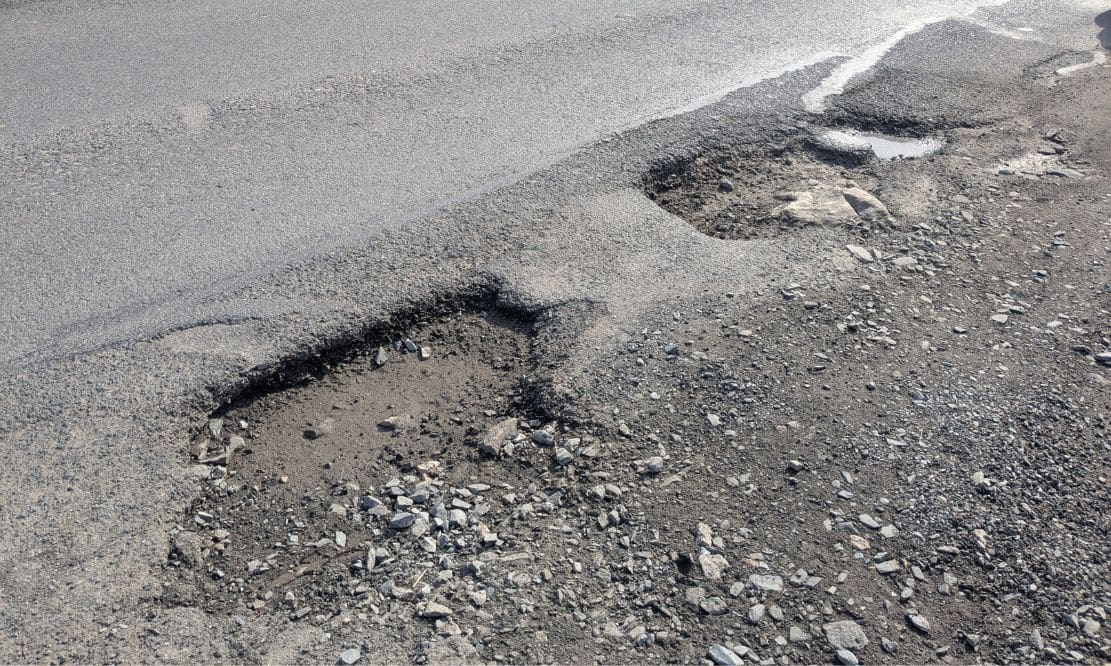
The Department for Infrastructure have defended the removal of pothole reports from the NI Direct website after a local eagle-eyed resident raised suspicions… however, its response seems to have just as many holes as the roads themselves.
The resident contacted Armagh I at the start of March after noticing for a period of months that his reports of road defects were disappearing from the NI Direct website but the potholes themselves remained.
NI Direct’s website boasts a feature where users can view a searchable map of their area and see all previous reports of defects and descriptions of those defects, which are then passed on to the Department for Infrastructure (DfI) for assessment.
The disgruntled resident said he first noticed issues at the end of last year but at that time had not made a note of the reference numbers associated with his reports. So, to be sure of his suspicions, he made new reports and noted those references.
Sure enough, he claims around six of the reports he made in 2026 have been “removed” from the map and says the potholes he reported have not been marked or repaired.
And, he is not alone. At a full meeting of ABC Council on January 26, Alliance Councillor Peter Lavery raised his own concerns.
The councillor proposed to write to the Infrastructure Minister, Liz Kimmins, and the Acting Divisional Manager, Cindy Noble, to request answers as to why this “batch update” was done and to see if it could indeed be undone.
Keen to run test of the issue, Armagh I reported two known potholes in the city centre that were currently showing as unreported on the NI Direct website at the time of the last article’s publication… one major hole on the Ballycrummy Road (outside the entrance to Campbell’s Trade Sales) and another on the Monaghan Road close to Mullan’s shop.
This publication recorded the references numbers for each report. Both were reported at the beginning of March.
Checking on March 18, the Ballycrummy Road report has indeed vanished. The Monaghan Road report remains.
When asked about the disappearance of reports on the website, a DfI spokesperson said: “Information provided via online reports or correspondence is forwarded to the Department’s maintenance team who will check and verify the report, often during the next scheduled inspection.
“Remedial action will then be arranged if the defect meets or exceeds the intervention threshold stated within the current Limited Service maintenance policy.
“Note, the pothole online portal displays a defect marker on the map after the customer clicks submit, however, this is removed when the defect is repaired, a site investigation is completed and the findings updated on the system, or is more than 6 months old.”
However, the Ballycrummy defect reported by Armagh I does not appear to have been remedied, which flies directly in the face of DfI’s response.
Not only has it not been remedied but it has not been marked as a defect nor does it display any visible signs that someone from the Department has attended the site.
It should also be noted – to be sure that it meets the “intervention threshold” – that the Ballycrummy defect is not one but two potholes, both considerable in size and depth.
Each could measure 3ft in length and are approximately two to three inches deep. Yet, neither has been marked.
Armagh I once again contacted DfI for further clarification in regards to how reports are removed from the NI Direct website, whether this be a manual or automated process and have sought clarity as to why the Ballycrummy Road report was removed.
Updates will be published when made available.