Who hasn’t heard uttered the words ‘sure it was a lovely send-off’ or ‘they did them proud’ by someone in the moments immediately following a funeral.
It’s an observation, an opinion freely offered.
But the idea of what a ‘send-off’ should mean or how in fact someone has been ‘done proud’ is changing – massively so – and has been for quite some time.
Now an Armagh-born academic is leading a major research study into how people here in Northern Ireland ‘do death’ – and what changing funeral, wake, burial and cremation practices tell us about identity, community and belonging.
To that end, Dr Sharon Mallon, a Senior Lecturer in Social Work and Wellbeing at the University of Staffordshire, wants to speak to and listen to the stories of locals to ensure traditions can be documented before they are forever lost.
The study has been funded by the British Academy, with the idea for the research born out of Sharon’s own experience of noticing how much had changed between her father’s death 25 years ago and upon her mother’s more recent passing.
Speaking to Armagh I, Sharon explained: “I’m hoping to document maybe how things have been done in the recent past and also to see how they’re changing.
“I’m from Armagh myself and I had a really significant bereavement 25 years ago with my Dad and things were done a very particular way. As a 26-year-old, we were kind of taught this is how it’s done, and then Mummy died three years ago and it was just so different.
“It was the same undertakers, same family, but things were just so different. It was a little idea that came from there really. I’m a bereavement academic. I’ve spent a lot of time thinking about bereavement in general.
“When I actually then went to look at what we had documented about Northern Ireland rituals, how death is responded to by people, the wee things that are important, there’s very little written about the everyday funeral. There is some stuff written about big political funerals, big statement funerals, but there’s very little written about the everyday experiences of people.
“When I started looking into it a little bit more, it looked like COVID was one of the tipping points for some of the traditions being lost or being changed.
“My goal is to document what people remember about funerals and to get them to reflect on how they’ve maybe changed.”
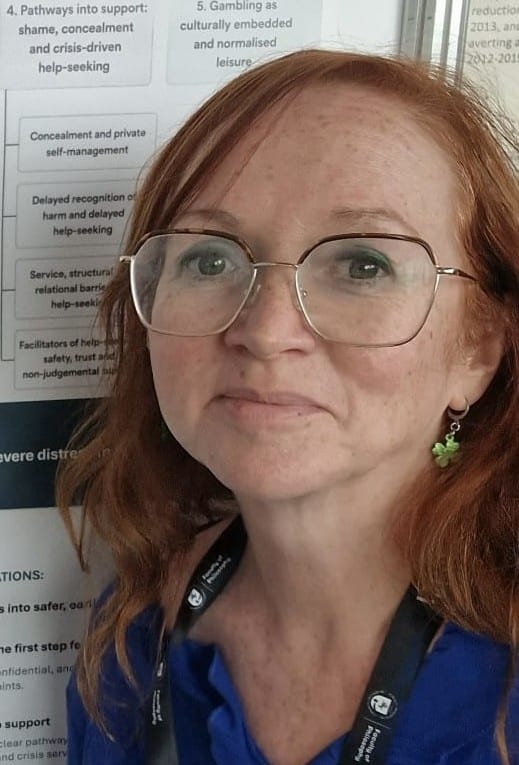
Dr Sharon Mallon
Next year, working with the Folklore Museum at Belfast, Sharon hopes to put on an exhibition, where the museum will display some of their historical material artefacts and document or show to people what she will have learned over the next year, on how things are changing, as a way of reflecting on what it’s like to live in Northern Ireland and to think about such things.
“We’ve only just started planning for that,” she added. “I’m also hoping that the voices of some of the people, if they consent, can be added to the National Archives, so that we have a kind of historical record of people’s memories of events and what are the really strong traditions that are meaningful to people and why do people think it’s changing right now.
“Is it through choice or convenience? Is it making it easier or better for people when they’ve just lost somebody or is it just happening without people even being aware of it, because sometimes we can lose traditions in that way. Or is it reflective of how Northern Ireland is changing? There’s a lot of diversity in Northern Ireland now. People are maybe not as religious as they once were, so it’s a kind of exploratory study in that sense. I’m not sure what we’ll find. Everybody I’ve talked to so far has an opinion on it or a wee story, which is lovely, and so it’s about capturing that.”
Working alongside historian Dr Peter Morgan Barnes, Sharon is inviting members of the public in Northern Ireland to share their own experiences for the project, which is entitled Death ‘Practices in Transition: Meaning, Ritual, and Change in Northern Ireland’.
The researchers will travel across Northern Ireland several times over the next year and will next be interviewing participants across the week starting this Sunday, October 25.
They are looking to speak to people aged 18 and over who have attended a funeral or wake in Northern Ireland within the past five years.
Said Sharon: “So far I’ve only done two pilot interviews and I suppose the things that are coming out from them is that it is a bit easier now, that some of the changes, particularly around like the opening of the Wake House or having the deceased at the funeral home, that that’s actually making it a little bit easier in those first few days.
“But people are saying, we don’t know why we’re not doing that anymore. There is a sense also that things are changing and people don’t really understand that, and so that will be something for me to reflect on and analyse when I’ve got more accounts.
“But everyone’s so keen to talk about it, which has been lovely. I’ve had so many informal conversations, with people who are saying how important it is to people, this time, when somebody’s just died; it’s a very important time for the family and for the community that come around together to support people who are bereaved.
“I’m looking to interview literally anybody, anybody who’s over 18 I’m looking to talk to them. It’s not even about a particular person who has died. Sometimes in Northern Ireland you go to funerals of people that you kind of know tangentially, and it is just about that experience, anybody who’s got an opinion.
“We’re trying to cover as much of the six counties as possible, because one of the big things people have said is it varies massively in what people seem to think is the normal thing that should happen or the traditional thing. I would love to get as many people as possible. I am particularly interested in getting some of the older generation, because they have a sense of how it used to be and that is important, but also there is a sense of it’s changing, so maybe looking at why it’s changing by interviewing younger people is also on the cards.”
So is there a resistance to change by some to dispense with the way things were done? A reluctance to part from ‘tradition’? Or is it a natural progression?
“I couldn’t tell you yet. I honestly don’t know,” admits Sharon. “There doesn’t seem to be a deliberate choice to change, is where I put my marker.
“I’m not sure that people are deliberately making these choices. It might be sometimes society sweeps up and changes without people even noticing it. It happens very slowly. So it’s one of the things I’m interested in because, if you think about my experience, it was 25 years between two very significant bereavements. I would have been to other funerals, but I wouldn’t have necessarily noted them in the same way.
“It would be something interesting to ask people as I go out now. Is this welcome this change? Is it something that’s happening without people even being consciously aware of and what would that mean? But it’s still a question I have.
“My personal sense is we kind of didn’t think about what it meant to make the changes until afterwards. We weren’t deliberately changing things, we were just getting swept up in the moment. So I don’t know that there’s a resistance to change. It would be interesting to discover that.”
Sharon also hopes, in time, to be able to make comparisons with how things may have changed between North and South.
Research has already been conducted, specifically in the west of Ireland, by a PhD student.
Sharon would also be keen to interview people who have relocated from the Republic to Northern Ireland to learn of any perspectives they might have in differences in attending funerals.
There are also comparisons to be drawn between different faiths too.
“My own experience is of having come from a Catholic background and I had very fixed ideas of how a Catholic funeral is done,” added Sharon. “But actually, the people I have interviewed so far who’ve been from a Methodist background, or a Presbyterian background, describes very similar things to what I would conceive as being tradition.
“So I’m really interested in looking at the similarities there might be, where we wouldn’t expect similarities, even among communities in the North that might think they do things very differently because, to my knowledge, that hasn’t been documented yet and I think it would be an enormously positive thing for community building in Northern Ireland, to just even understand that things are not so different, or even if that is part of why people are letting things go because they don’t want that distinction.”
The idea of a ‘send-off’ – and what it actually means to do it ‘properly’ – is something which is changing and understanding why and how is key to what Sharon is trying to document.
“The send-off is still very important to people, absolutely. It has to be done right,” she said. “But what right is defined as and who defines it is important and doesn’t seem to be easily got at, and that’s why I want to interview as many people as possible, to get that sense of where do those ideas come from?
“We’re interviewing next week ministers and priests and humanists, to get their sense on where the steer comes from. Does it come from the churches or even the humanists? Or is it coming from the people kind of feeding back? In reality, the history shows us there’s a two-way dialogue there and that the historical context is that, at times, wakes have tried to be controlled by the churches and curtailed, if you like.
“There’s a whole history to that, but people want things done their way as well, so there’s a dialogue there. It’s not straightforward in terms of how people decide what should be done and I think it’s going to be interesting to see how that is reflected in what’s happening right now.”
That dialogue will also include the voices of undertakers, with a number of interviews already lined up.
Among those Sharon hopes to speak to it the undertaker responsible for her mother’s funeral.
“There was a steer from the undertaker and I’m interested in exploring with them again. Is that a dialogue? Is it what they’re picking up on?,” she added. ” Is it something that they’re also helping to direct?
“The examples that I have been reflecting on are that you didn’t need to stay up all night with the body anymore – that was the biggest change – and that the house was private. You had opening hours and yet, in the case of my own father, one of the most comforting things was his friends coming very late in the evening and telling stories about him and in a way that wouldn’t happen in ‘civilised’ opening hours.
“But on the other hand, when Mummy passed, we did have hours, we had more time as a family, but there was something lost and that was what I was reflecting on, that we’ve kind of lost something, and have we replaced it meaningfully with something else?”
For Sharon, she views the work being done as not just important but “absolutely vital”, particularly as somebody who realised that big political funerals had already been well documented.
“It’s important for the everyday person in Northern Ireland to have their experiences documented and that’s what this is about,” she explained. “It’s about moving past a history where we were defined by the Troubles and our experiences of what happened and actually thinking, what’s it like to live and experience big significant life events, like a death, in Northern Ireland, and how have we managed those in the past and how are we managing them now?
“It’s a way of tracking our transition as a society as much as anything, but also acknowledging the everyday person’s meaningful existence.
“I want to speak to as many people as possible because I genuinely do think this is an important thing to document before it changes completely and we lose it and we don’t even know that we’ve changed it.”
The researchers will make one of a number of visits to Northern Ireland in the coming week and anybody who would like to speak to them is asked to get in touch. Interviews will last approximately 30 to 40 minutes and can be conducted online, or researchers are happy to travel to speak to people in person. No specialist knowledge is required, as they stress they are just interested in hearing about people’s experiences and observations.
“Things have changed massively,” added Sharon. “It made me think about what we carry forward, what changes and what we risk losing if these stories aren’t recorded.
“This is an opportunity to document the ordinary lives of people across Northern Ireland and the rituals that matter to them. The ways we gather, say goodbye, care for one another and remember those who have died are an important part of our shared history.
“Hallowe’en has long been associated with transition and the idea that the veil between the living and the dead is at its thinnest. It feels like a fitting moment to hear from people across Northern Ireland about their experiences of funerals and the rituals that help us remember those who have died, navigate loss and make sense of life and death.”
Anyone interested in taking part can contact Dr Sharon Mallon at sharon.mallon@staffs.ac.uk for more information and details of the study.