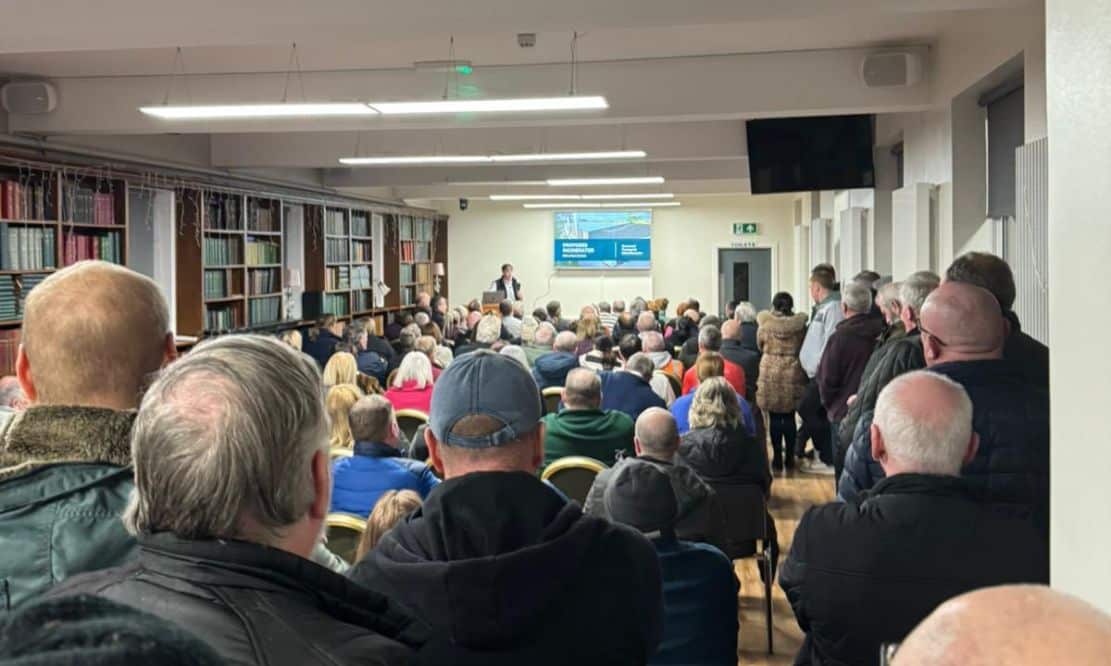
Benburb Priory’s blue room could scarcely hold the number of concerned residents that turned out to discuss proposals to develop a contentious new heat to power plant near Milltown.
A rough count of the room indicated there were some 140 people at the meeting which kicked off shortly after 7.30pm of January 7.
Organised and run by residents of the area under the group name ‘Residents Against Incineration’ (RAIN), the purpose of the event was purely to “make note” of concerns and to gauge interest for the formation of a committee to research and potentially challenge proposals put forth by AIC Group to build the plant on lands at 111 Milltown Road.
From the minute neighbours were notified of the company’s intentions to develop, what is being labelled locally as an “incinerator”, there has been stiff public opposition to any formal plans the company may wish to submit for approval by Council in the near future.
Among concerns noted by residents, there are worries surrounding the type of waste to be deposited to the facility, emissions created through incineration, traffic implications on an already “poor condition” carriageway, noise pollution, environmental contamination, property devaluation, the impact on future generations and the ramifications for human, aquatic and livestock health.
AIC Group held a public consultation meeting in Armagh City Hotel on December 22 to provide the public an opportunity to ask questions and hear informed replies.
Related: Armagh engineering firm respond to public concerns surrounding plant development
Armagh I attended that meeting and spoke with several attendees, some of whom where there in support of the facility.
However, on the evening of the RAIN event, it was apparent that concerns had not been fully addressed – or assuaged – by the company at their consultation meeting.
At the meeting on January 7, those public concerns were once again heard – this time collectively – over the course of a 90-minute meeting.
Showing an on-screen presentation, a member of RAIN said: “What we know so far is that feedstock will be non-hazardous and hazardous waste, including medical and veterinary solvents, corrosive paint, PPE and untreated timbers which are all going to be incinerated at the side.
“The plant is proposed to run 24-7 with waste deliveries Monday to Saturday. Waste will also be transport in lorries to the facility via the Milltown Road.
“Kerosene will be used to fire the combustion process. The process will have the capacity to generate around 1.6 megawatt electricity, most to be exported to the grid.
“Internal liquid effluent will be collected in an internal interceptor tank and be taken away for treatment monthly. Incineration has a number of by-products including flue gases, fly ash, bottom ash and liquid leachate.”
In terms of what RAIN say they “don’t know”, the spokesperson listed: “Sources of waste… we understand they’ll be sourced somewhere in Northern Ireland, but we do not know where; the quality component and properties of waste to be processed and the destination of by-products including bottom ash; air quality impact on local human receptors; understanding the plume distribution of contaminants, of potential human health effects, respiratory, cardiovascular, reproductive and mental health, all being issues; impact on ecological receptors, farmland, livestock, and food chain; impact on natural, unbuilt heritage sites; how external drainage will be managed; potential impact on ground watercourses; an accident and disaster management plan; infrastructure and route to delivery that they are to deliver electricity generated to the grid; the road infrastructure changes that will be implemented; what alternative more suitable locations have been considered for the proposal and future modification expansion or potential; the size of the facility; what waste volume it takes; impact on property value, future residential planning, constraints and impact on future generations.”
While attendees were all provided the opportunity to speak to the concerns outlined in a controlled and fair manner – and all who raised hands were passed the microphone – the overall message from RAIN was to ensure that concerns were “not only spoken privately to next-door neighbours” but were put forward in writing to the company, any committee that may be formed to handle objection to the proposals, to local representatives or to Council directly.
Those who spoke, did so passionately, and thus several received agreeable rounds of applause from the audience in concluding their say.
Among those who spoke was one woman who asked, “Is this business over the lives of people?” as she aired her concerns for public health and quality of life if the facility were to be green-lighted.
Another warned of “risk mitigation” as opposed to “risk elimination” when it came to air quality reports and environmental assessments that the company will have to provide as part of a formal planning application adding: “Just have that in your mindset.”
A local architect – not related to the project – spoke to inform those in attendance that they did not have to wait until a Pre Application Notice (PAN) had been submitted by AIC Group to make an objection or raise a concern. He advised that anyone wishing to formalise their concerns could write an email to the company’s representation – NI Planning Consultants Ltd – and that these would then have to be “included as part of their pack” when submitting formal planning notification.
Sinn Féin MLA, for Fermanagh and South Tyrone, Colm Gildernew – who also attended the public consultation at Armagh City Hotel – spoke to commend the organisation on having received an impressive turn-out on the evening and for hosting a “very fair” and “informative” meeting.
He continued: “This community is entitled to a voice. People are entitled to bring forward planning proposals but, by the same extent, people here are entitled to their say and I think the extent of representation here tonight is really important… and that needs to be maintained.
“I think it’s vital to understand that this effects much more than just the Milltown, Tullymore, Tullysaran areas. This will effect – depending on prevailing winds and water – this whole section of Tyrone and Armagh. I think it’s crucial that people do bear that in mind.
“I would encourage people to support the Facebook site that the guys here are floating that is going to be set up because they are right about this, this will take a strong and concerted effort and a united community effort. There’s no question about that.”
Of the points addressed over the course of the evening, the MLA said he believed they had all been “very well made”, they were “exceptionally valid” and that his “final call” would be for the community to “maintain their focus” and to put their names forward for any committee that will be established in the coming days.
RAIN have now established a Facebook page (Residents Against Incineration) to keep interested parties abreast of developments and to provide information garnered through their own independent research moving forward.
Another meeting will be held in due course with a date to be determined. It will be announced via their Facebook page and they, again, encourage all those with a vested interest in the project to attend.
AIC Group are due to submit a Pre Application Notice with an outline of their proposals in February whereby a second public consultation meeting will also be held.
AIC-Group response
Armagh I contacted AIC Group for a response to resident’s concerns. AIC Group provided a comprehensive response which reads, as follows, in full: “From the outset of this process AIC Group have been transparent as to the scale and purpose of the proposed development and have at every avenue possible engaged with local residents, at present we have received a limited number of questions and or concerns via our feedback forms distributed at our first public meeting held in December or via email following the event.
“To date, no planning application or permitting permission has been lodged nor shall it be lodged prior to our next meeting.
“Due to the fact that AIC Group were not invited to the meeting, and in the interest of respecting the group’s decision to exclude us from the event, we felt the delivery of the below letter to address the meeting was the most appropriate method however we cannot comment if this letter was presented to the public at the meeting or not: ‘Thanks for taking the time to speak with me this morning, we would like to take this opportunity to acknowledge the community organised meeting to be hosted at Benburb Priory this evening and its purpose of centralising any questions and concerns on behalf of the local public.
“‘AIC Group welcome this opportunity for open dialogue and would like to once again confirm that we are keen to engage constructively with local residents and are committed to listening to and addressing any questions or concerns raised.
“‘At present, no planning application or permitting permission has been lodged nor shall any be lodged prior to the outcome of our next meeting which is scheduled at present for February 2026.
“‘Once the details have been confirmed on our side we will advertise in the local media and via the local community Facebook pages and ensure sufficient notice is given.
“‘Our intention is to work collaboratively with all stakeholders to ensure that the proposal is fully understood and that any and all concerns are both considered and addressed. We believe that meaningful engagement is an important part of the planning process and look forward to ongoing discussions.
“‘Following our previously organised public meeting in the Armagh City Hotel on the 22nd of December 2025 we have to date received only a limited number of correspondences via feedback form at the event and email following the event. We appreciate that many people will have a range of questions on the proposed development and are keen to answer them.
“‘If it is feasible during tonight’s meeting, we would request that any questions or concerns be noted and submitted to us via email to pan@aic-group.co.uk or stephen@niplanningconsultants.com. This would allow us to address the matters raised and would then form the basis of our next public meeting with a formal reply being issued prior to the event.’
Continued AIC: “We fully support the establishment of the group as a means of voicing any and all constructive concerns and questions. If managed correctly the group would offer a centralised point of contact and would allow us to address constructive questions and concerns formally submitted to us prior to our next meeting should the group chose to do so.
“In recent weeks a significant volume of commentary has circulated on social media and other informal platforms concerning the proposed thermal treatment and combined heat and power facility at Benburb.
“Much of this commentary reflects genuine concern within the community, which is entirely understandable. However, a number of statements being widely repeated are factually inaccurate or based on misunderstandings of how such facilities are regulated and operated.
“It is imperative, to ensure that public discussion is grounded in fact, and to support informed engagement with the planning and environmental processes that apply.
“First, it is important to be clear that facilities of this nature are not unregulated, experimental or operating in legal uncertainty. They are subject to a well-established framework of planning control, environmental permitting and continuous regulatory oversight.
“Planning permission alone is insufficient for operation. A separate environmental permit is required, imposing legally binding limits on emissions, waste handling, odour control, water protection, monitoring and enforcement. Failure to comply with those conditions can and does result in enforcement action, suspension or closure.
“There have been repeated assertions that such facilities are banned elsewhere in the United Kingdom. That is not correct. Thermal treatment and energy-from-waste facilities continue to operate lawfully across the UK, subject to national and local policy tests.
“While different administrations apply different policy emphases, there is no blanket ban, and each proposal is assessed on its own merits against evidence and regulation.
“Concerns have also been expressed regarding potential impacts on air quality, public health and the wider environment. These matters are not left to assumption or reassurance; they are assessed through detailed technical analysis. Before any facility can operate, it must demonstrate through recognised modelling that emissions comply with strict statutory limits at all relevant locations, including nearby homes and community facilities.
“Emissions are continuously monitored using certified equipment, with automatic shutdown procedures triggered in the event of any exceedance. These limits are derived from established public health evidence and are enforced by regulators, not by the operator.
“Specific concerns have also been raised in relation to odour. Odour control is a core regulatory issue and is addressed through both design and operation. Facilities of this nature are required to operate within fully enclosed buildings, with waste delivered in sealed containers, unloaded internally and stored under controlled conditions.
“Handling takes place indoors, and ventilation systems are designed to prevent odour escape. Odour management plans form part of environmental permitting, and any substantiated odour nuisance would constitute a breach of permit conditions, subject to enforcement.
“Odour is not treated as an inconvenience to be tolerated, but as a regulated environmental impact to be prevented.
“Similarly, claims regarding risks to local watercourses or water supplies do not reflect the proposal or the regulatory position. Facilities are not permitted to discharge process water to rivers or groundwater without specific consent. Internal wash-down and housekeeping water is captured and removed for licensed treatment, and water protection is a fundamental component of environmental regulation.
“It is also important to recognise that the planning and permitting processes are transparent.
“Technical assessments, consultation responses and regulatory decisions are subject to scrutiny. Members of the public are entitled to review information, to ask questions and to make representations. That engagement is most effective when it is informed by accurate information rather than speculation or repetition of incorrect claims.
“Public concern should never be dismissed, but neither should fear be amplified by misinformation. The purpose of regulation is to ensure that developments proceed only where they can be demonstrated to operate safely, responsibly and in compliance with the law.
“The proposed development will be assessed on evidence, expert analysis and statutory controls. It will not be approved by assertion, nor rejected on the basis of inaccurate claims.
“The community is encouraged to engage constructively with the process, to seek clarification where needed, and to participate on the basis of fact.
“Meaningful discussion depends on accuracy. This letter is intended to help restore that balance.
“To date despite our best efforts, we have received only a limited number of questions and concerns formally raised to us. We would like to take this opportunity to once again request that local residents utilise the pan@aic-group.co.uk or stephen@niplanningconsultants.com as a formal method of submission.
“Our intention is to collate these submissions and address them fully prior to our next public meeting in order to set a basis of further discussion. The meeting is set in principle for February 2026 but yet to be confirmed.”