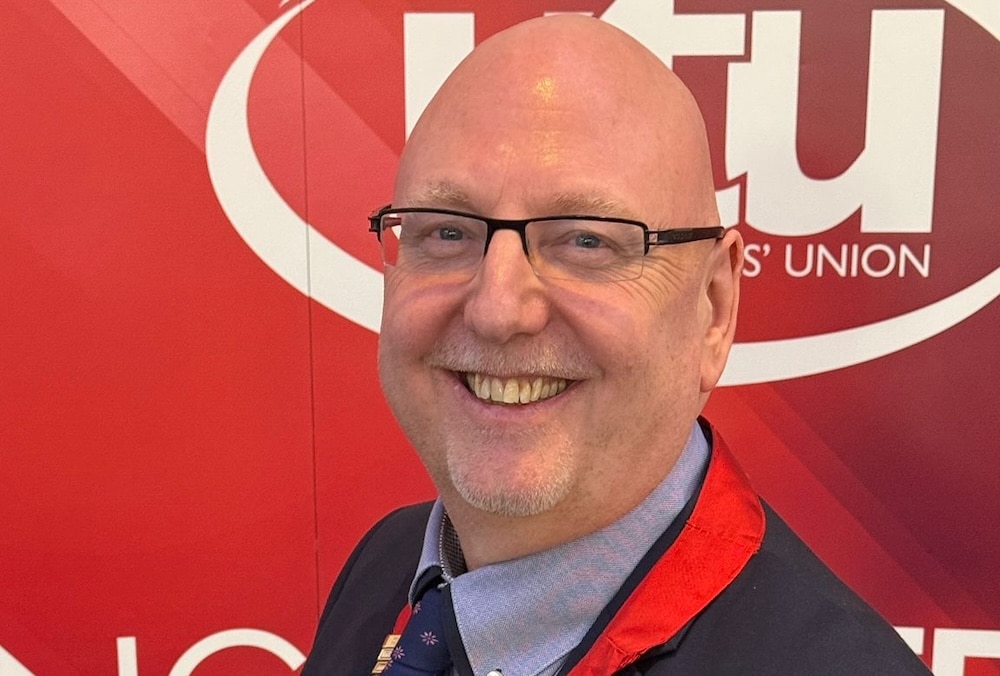
An Armagh man has been appointed President of the Ulster Teachers’ Union.
Jon Bleakney, principal of Co Down’s Lakewood school, the only secure care facility for under-18s in Northern Ireland, wants to use his Presidential year to highlight the needs of vulnerable children.
However, he fears the secure care sector in NI is in crisis, with children as young as nine being locked up for their own and others’ safety.
“It’s a huge thing to deprive a young person of their liberty but these are young people who have to be locked up for their own and the wider community’s safety,” says Mr Bleakney.
But he’s at pains to distance the kids in his care from the so-called ‘borstal’ boys and girls of bygone years.
“The narrative has radically altered in the 30-plus years that I’ve worked in the secure care sector. We now know these young people are the result of their environment – indeed it starts before birth,” continues Jon, who was born in Armagh but now lives in Belfast.
“In the past people only saw the ‘bad behaviour’. We see the child and look for what’s behind the behaviour – usually they’re just reacting to deeply disturbing experiences.”
Lakewood students don’t come through the justice system but via the care system. They end up here because they need a more intensive and secure environment.
“That can be due to being, for instance, sexually or criminally exploited, mental health or addiction issues,” says Mr Bleakney
“Their aggressive behaviour is usually the result of developmental trauma and is the only way they know how to communicate.
“Ironically violence has protected them even though it’s completely outside societal norms,” continues the father of four who’s seen a fundamental change in the profile and even age of the students coming through.
“We’ve had a wee boy of nine which is as sad as it is shocking; but the challenges our students present with are also changing.
“Just as in the mainstream where we’ve seen a surge in children with special educational needs and in prisons where we’ve more adults with mental health and learning difficulties than ever, the same is true for Lakewood.
“However, the system is doing these young people a disservice by not having earlier interventions to support them.
“But then our government can be very short-sighted at times. They need to deal with what’s causing the behaviour.”
That though may take longer than the secure care sector would like because of upheaval within SEN in mainstream schools.
“All schools are now essentially being forced to cater for children with SEN and that will be hugely challenging,” said Mr Bleakney, for whom it was a conscious choice to work in secure care.
“Growing up we were a bit like nomads. I was born in Armagh but my father was in the RUC so we moved around a lot and I attended a few schools before studying at Stranmillis where I’d the chance to work with disadvantaged kids.”
That experience fuelled his passion for the sector where, as a fresh young graduate, he wanted to ‘make a difference’.
“It was very much a conscious choice to work here even though at that stage, as Rathgael Training School, it wasn’t overseen by the Education Boards but by the NIO,” continues Jon.
“When the Department of Education took over in 1999, it became Lakewood school.”
Thirty years later, however, Jon fears the secure care sector is in crisis.
“Because of the changing profiles of our students and the increasing trauma with which they’re presenting – not to mention the ever growing numbers – we simply can’t meet the need here,” he continues.
Students can end up in units in the Republic or GB, all of which adds to their trauma, despite the fact the NI Review of Children’s Care Services by Professor Ray Jones made swingeing recommendations to improve the service over three years ago now.
“We can’t afford for this to be yet another review commissioned by Stormont which lies unheeded,” says Jon who admits the job is at times emotionally challenging.
“We used to ask new staff how they’d feel about being punched or kicked now we ask how they’d feel hearing some really disturbing stuff from these traumatised young people.
“The last thing we want is to end up with compassion fatigue where the child in front of you is just a list of tick boxes – yes they’ve been sexually abused, yes they’ve addiction issues and so on.
“We have to be strong for the kids but it is challenging so we ensure we’ve a strong staff support network.
“Working here though makes you appreciate your own life and family for these kids are disadvantaged even before birth.
“Maybe the mum-to-be has addiction issues that can affect the developing baby maybe she’s living in a violent home so her cortisol levels are through the roof.
“All this can impact the development of the unborn child’s brain, the amygdala, the frontal cortex, feeding into how they will later respond to danger, real or otherwise, potentially fuelling their hyper vigilance and anger as they grow up.”
It’s this understanding of the young people in his care that Jon wants to spread during his Presidential year – that and the fact that there is hope.
“One of our former students now works here as a youth worker. To see that young man come full circle is amazing. He’s been through it all – prison, addiction services, then university and now in the workforce.
“His story shows young people here – as well as our staff and teachers facing challenges in mainstream schools – that there is always hope.
“Every day when I see that young man it gives me a real lift.”