When an Armagh teenager first put pen to paper to ‘give it a go’ in a schools poetry competition, he never could have imagined where it would lead.
That schoolboy was Daragh Carville.
And from that teenage poet of many moons past, today Daragh’s own life’s script has taken him to the top of his game, the creative mind behind one of ITV’s biggest and best-loved dramas, The Bay.
First aired in March 2019 and attracting a prime time TV audience of over seven million viewers, The Bay has been commissioned for a sixth series, with filming having started just last month.
It’s a far cry from his days in Armagh.
But it was growing up here, among family, friends, community, school, where Daragh’s creative spark ignited a burning passion to pursue a life in the arts.
“I’m Armagh born and bred,” he proudly and emphatically informs Armagh I, taking time out from his extremely busy schedule for a chat.
“My mum still lives on the Cathedral Road and I have lots of friends in the area. We actually lived in College Street when I was born but then moved to Cathedral Road when I was three years old or something. I’ve very early memories of College Street and then, from 1972 on, we were on Cathedral Road, just across from Sherry’s Field. I have lots of memories of playing across the road, and up the back of the house around the Cathedral.
“The whole kind of area was like a big playing ground for us. It was a warm community to grow up in.”
One of four boys, Daragh and his brothers – Conor, Barry and Gavin – attended Foley Primary School, in Ballymacnab, where mum Maura had been teacher and principal. His father, Cyril, originally from Castleblaney in Co Monaghan, had been a psychiatric nurse at St Luke’s but sadly passed away in 2020.
It was after sitting his 11+ transfer test that he attended St Patrick’s Grammar School – or ’the College’, up on the hill, as it was known to most at the time – the family living in its shadow mere yards below.
Daragh, now 57, has fond memories and credits his early education – and one influence in particular – for his success to date.
“I had a great time there,” he says of his time at ‘St Pat’s’. “ That was kind of where I discovered writing and drama, and all of the things that have become such a big part of my life.
“I was lucky enough there to have the archetypal, inspirational English teacher, who was Paul McAvinchey, still a good friend of mine, who has been an inspiration to generations of artistically-minded young people growing up in Armagh. He’s been such an important figure over the years and still very involved in the arts in Armagh.”
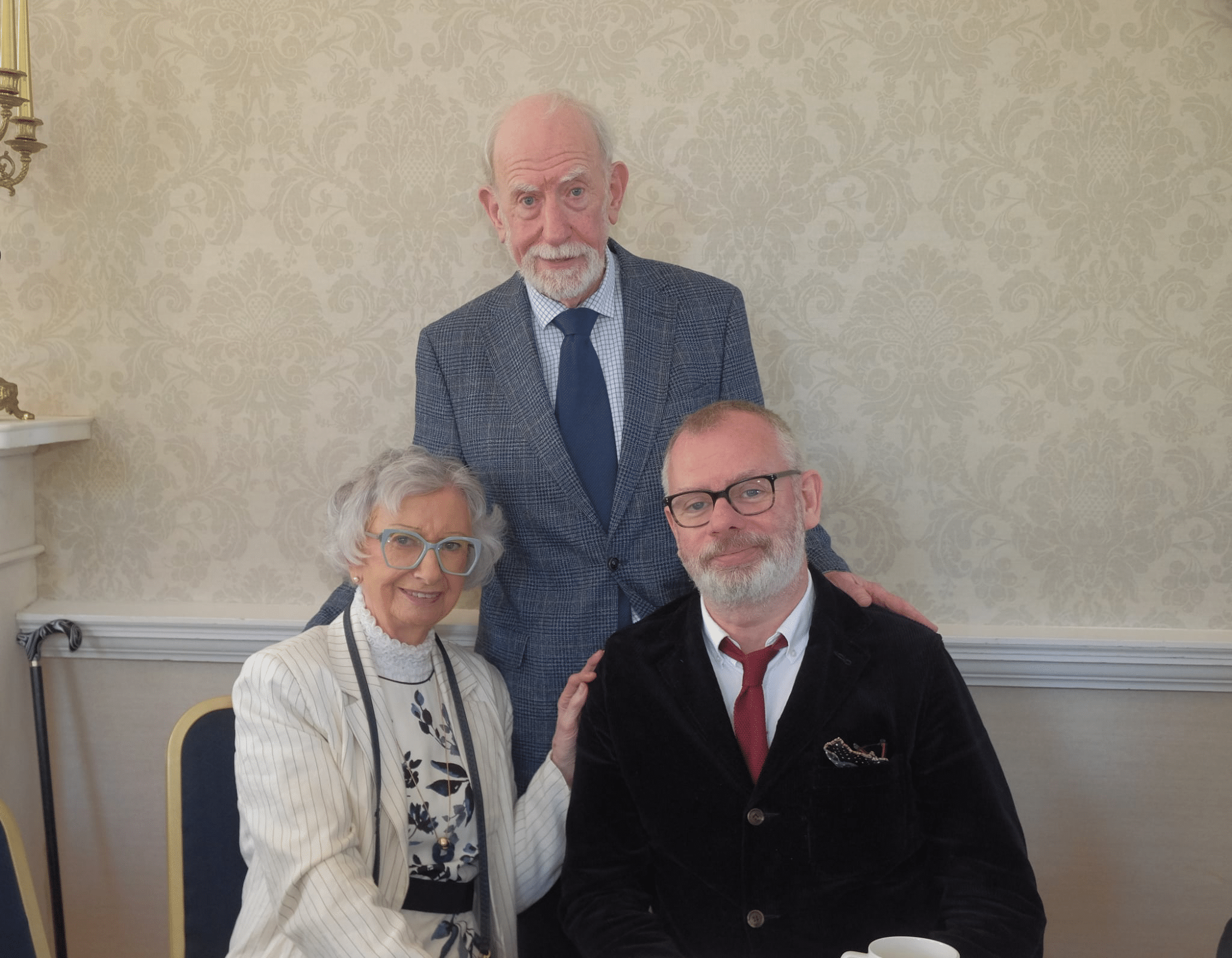
Daragh and his mum, Maura, with Paul McAvinchey at the Palace in Armagh for a celebration of Paul’s contribution to the Arts. Picture by Liam McArdle.
Paul, long since retired from teaching, has been the driving force behind the John Hewitt International Summer School, a week-long celebration of the arts hosted at the city’s own Market Place Theatre.
For Daragh, he has been a frequent contributor to and participant in the Hewitt School, which is due to run again in a few weeks time.
While Daragh unfortunately will not be able to attend this year, he hails its influence – and the wealth of creative talent to have emanated from the relatively small city of Armagh over many, many years.
“Paul is such a big part of that,” he says. “That’s been great for him, and obviously the theatre itself is brilliant, but having that big arts event every year, it’s great for the city.
“When I think of all the people, my contemporaries, who have come out of Armagh around the same time and gone on to work in the arts, like the director, Brian Kerr, and the actor, John Paul Connolly, the writer, Terry Cafolla, and Seamus McGarvey, the great cinematographer; there’s actors and music people and all sorts.
“Armagh has been a place that has generated a lot of people interested in the arts and who have gravitated into that world. I actually think Paul McAvinchey has had a big part play in all of that.”
It was under the guidance of Paul that Daragh first entered that school competition – the Patrick Kavanagh Poetry Prize – which would set him firmly upon his career path.
“It had a junior, Under 16s category, and Paul encouraged us all in the old English class to give it a go,” he explains. “I wrote a poem and I didn’t win the competition. I think I came second, but I got £30, which was a lot of money whenever it was, 1984 I think.
“At that stage, I was excited about that. It was the first time I’d written something and it had been recognised, so that’s when I started to think, actually, this is what I want to do. I always kind of knew I wanted to be something artistic, because I grew up with drawing and painting. My mum paints and we were always encouraged to be interested in the arts, so I knew that’s what I wanted to gravitate towards, but it was only when I did that and I was in that Patrick Kavanagh competition that I sort of thought, actually, no, maybe it’s writing rather than something else.
“Then I went to university in England and did drama and film and, out of that, I then started properly writing, as such, and it was very much drama that I was drawn towards.”
In the years which followed, Daragh would write for both stage and screen, including screenplays for two feature films, putting words into the mouths of acclaimed actors such as Matthew McFadyen, Daniel Mays, Robert Sheehan and Rupert Grint.
“I’d written a bunch of plays,” he adds. “I did a lot of work with the Belfast company, Tinderbox, over the years, but I’d also written plays for other companies and had a play on at the Peacock in Dublin. I also wrote a couple of pieces for the National Youth Theatre in London.
“I was working on plays and writing the odd wee bit here and there for radio and TV, and then I got the chance to write a feature, so I wrote two. I wrote Middletown and another one called Cherrybomb.
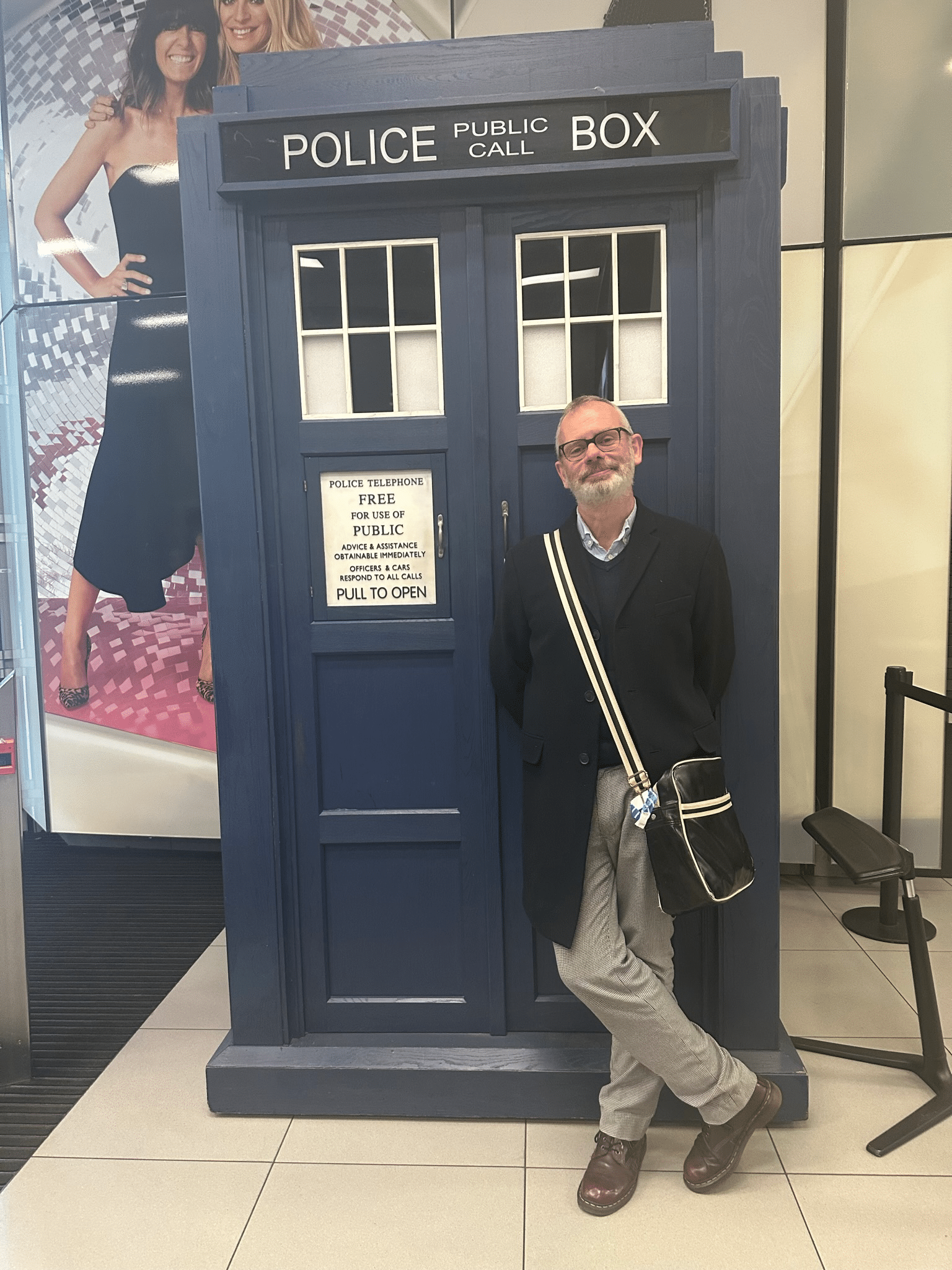
Daragh pictured at the BBC.
“After that, I started gravitating more towards writing for television, but I’m still interested in writing for stage as well. I’m interested just in any form of drama.”
The Bay – so named for its setting in Morecambe Bay – has been the pinnacle for Daragh.
As they say, all good things come to those who wait – and that’s true for both writer and audience.
For the hit drama did not come about overnight; indeed, the idea came about purely by chance when Daragh was listening to the radio news…
“I’d been working writing for television for a while. I was working on other people’s shows, writing an episode here and an episode there, but I was always trying to develop my own thing,” he recalls. “I really wanted to be writing for my own show rather than somebody else’s. I was trying to work out an idea for a crime drama that wasn’t just a pure police procedural thing.
“I wanted to write in the crime and thriller genre for TV, but it needed to be something else. It needed to bring more of my own sensibility to the storytelling, so it needed to be about family and community, which are things that I tend to write about in plays and stuff.
“I was trying to work out what that would be and I just stumbled on a story. I was listening to the radio one day and the news was on, and they were broadcasting from a courthouse, the family of the victim at a murder trial. The family made a statement, and in this statement they thanked the family liaison officer of the police who had worked with them, and said we wouldn’t have got through this without her.
“That was kind of like a lightbulb moment, because I thought that figure, that family liaison officer, or FLO, could be the heart of a show that would be both a crime drama and a family drama, because the FLO is a police officer that goes in to a family when they’re dealing with the trauma of a crime and works with them and helps them through that, but also is there primarily as an investigator, so they’re there to try and get to the truth.
“That just suggested itself as an idea for a story. I did a bunch of research. I met a number of FLOs and talked to them and just tried to work out what kind of person does this job. I just asked them and I developed the character and the kind of world of the show.
“Then also, because I was living in the Morecambe area, and living in Lancaster, which is just next door to Morecambe, I was very conscious of this place. I was always intrigued by Morecambe. It’s like one of the seaside towns around Northern Ireland as well, a place where you can sort of feel the kind of slightly faded grandeur of what it might have been like in its hey-day 100 years ago or something, when everybody went on holidays to the seaside, but it just slightly lost its reason to be with the fact of cheap holidays in Spain.
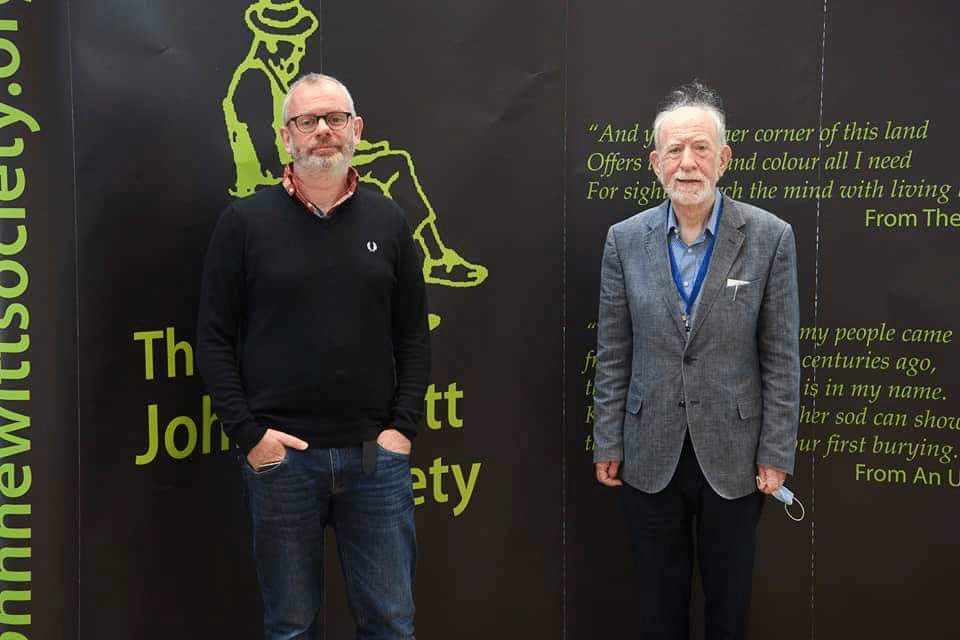
Daragh Carville, with Paul McAvinchey, at the John Hewitt Summer School in Armagh. Picture by Liam McArdle.
“So it has a slightly faded grandeur to it, but it’s also very beautiful, just looking out from the beach and over the bay itself and towards the mountains of the Lake District. I mean, it’s a really stunning place. I thought it had a real interesting combination of, on the one hand, it’s beautiful, but on the other hand, it’s also gritty, it’s a place where there is real deprivation, there’s real poverty, and I thought all of those elements together created something quite interesting.”
Daragh took the idea to Catherine Oldfield, co-founder of Tall Story Pictures, and it “just clicked” with her.
“The next thing I knew we were working together and brought it to ITV and they liked it,” he adds. “It’s kind of been all go since then. We’re on series six now – we’re actually shooting at the moment – so it’s been a bit of a rollercoaster.
“I’m the lead writer, or showrunner, on The Bay, but I’m also executive producer, so I’ve got a bit more of a role than some writers, in that I’m involved in various aspects, casting, the edit. As part of that, I do try and get along to set. I went to see everybody last weekend in Morecambe just to say ‘hi’, because we’d just started and I just wanted to show my face. I do try and get along. I’m not there all the time, by any means, because a lot of the time I have to be at the desk, writing the next script, but I do try and get along when I can.”
Now into the sixth season of The Bay, Daragh has found that he can write with the actors as much as the characters in mind.
And when he is writing the script, it does not always appear on screen the way he pictures it in his mind.
“That can be a good or a bad thing,” he admits. “Sometimes it’s like, oh no, this isn’t quite what I imagined. If you’ve written a scene and in your head it’s happening at night and it’s very atmospheric, and then it turns out that, because of the budget and the timetable and everything, we’ve had to shoot it during the day, it’s a different thing. That sometimes happens, but then the opposite also happens, which is there’s something you hadn’t planned or hadn’t quite imagined that way, and actually what happens on screen is much more exciting, more interesting. It’s swings and roundabouts.
“With something like The Bay, because it’s been running for a while now, the sort of core cast, I really know characters and those actors really well, so I can write towards them. They’re very much in my mind as I’m working. Hopefully I write to their strengths, but also try and keep it interesting for them, try and keep pushing the characters into new territory, because that’s just more interesting for them as actors, but also for me as a writer.”
While the longevity of The Bay allows Daragh to flesh out those characters as each series progresses – and he is hopeful of a season seven, with much more to explore – he certainly takes nothing for granted.
“It’s a tough business. It is a tough industry, and especially at the moment, there are a lot of people out of work in the TV and film industries in the UK and Ireland,” he adds. “So I’m very lucky to have this kind of opportunity, to not just tell the one story, but to continue telling new stories in this world that we’ve managed to create there.
“We never know from one year to the next whether it’s going to go again, but there is kind of built into the idea of the series, there’s a kind of story engine, as they say, which is the idea of this family liaison officer going into a family, so every year there’s a new crime, a new family for our FLO to work with.
“ There are more ideas for more stories we’d like to tell, so yeah, we certainly hope that we get a chance to do that. At the same time, I’m very conscious that six series is a pretty bloody good innings. We’ll see how it goes. It’s in the lap of the gods at the moment.”
Diehard fans will be keeping fingers crossed but, for now, when might we expect to see the next instalment?
“We’ve been shooting for the last few weeks, so there’s still at least a couple of months, more of shooting, and then you go into the whole post-production process, the edit and all of that,” confides our inside man. “I think the current plan is it’ll be on some time next year. I’m hoping the first part of next year, but these things have a tendency to move about sometimes.”
Daragh is based in England, which he lives with his wife, novelist Jo Baker, and children Daniel and Aoife. He divides his time between ‘up north’, in the Lancaster, Morecambe area, where The Bay is filmed, and London, where he also teaches script-writing at Birkbeck University of London.
But he loves to get ‘back home’ to Armagh at any opportunity.
“I was there about a month ago and I’ll be back again soon,” he says. “I try and get over as often as I can to see Mum – who turned 90 in March – and also to catch up with mates who are still there.”
Two of Daragh’s brothers, Barry and Gavin, still live and work in Northern Ireland.
Barry teaches at Foley Primary, where his mum also taught and was principal; while his older brother Conor, based in London, teaches at Reading University, a Beckett scholar and published poet who has written books of poetry and academic criticism. Youngest brother Gavin, meanwhile, lives in Belfast and works as a librarian and archivist at Stormont.
“I’m very, very proud to be from Armagh. It’s a place that I love very dearly,” adds Daragh. “On my Mum’s side, my family go way, way back. My granny, who used to live with us, she was a Mallon, and the Mallon family in Armagh go back to the beginning of recorded time!
“The Mallons were the hereditary keepers of St Patrick’s Bell, which is one of the great treasures of Armagh. So there’s a lot of history there for me, not just in terms of my own life, but even just in terms of thinking back through generations.
“My grandfather used to own a garage that stood where subsequently the fire station was and now it’s the Irish language centre there at the Shambles. The stone gateway at the side of it, that used to be the entrance to my grandfather’s garage that he had there in the 1920s and ‘30s, I think it was, and I’ve got a photo of him standing in that archway. So yeah, I’m Armagh through and through.”
Now, as one who has been there, seen that, done that and purchased the proverbial T-shirt, from where it all began, it would be remiss of us not to seek Daragh’s advice to other young artistically-minded teens who perhaps, with a dream such as his, are wondering where do I go from here?
“I would just say, do it. That’s the thing. It’s one thing to dream, we all do that to some degree and I certainly did when I was younger, dreaming about working in this world,” he says. “But you’ve got to put yourself out there and actually put pen to paper. Work hard, but also be forgiving of yourself, because the first thing you write isn’t going to be brilliant. The writers who make it are the people who don’t give up. The ones who go, OK, well that wasn’t very good, we’re going to scrap it and go write another one, and keep going, and then you gradually start to build your muscle.
“It is a kind of field where the more you do and actually the older you get, the better you get at it, if you stick with it. But if you give up, it’s never going to happen. I know that’s difficult, because we all have to live and pay our rent and whatever, but keeping going is the really crucial thing.
“And it’s more important than ever, I think, especially in these days of AI and all of that, that we have real people, human beings, telling stories, and not just people who are born to it and privileged and have the time and money to decide, oh, I’m going to take some time out to write a feature film or something. Real people who have real lives.
“It’s just so important that voices are heard from across the spectrum.”