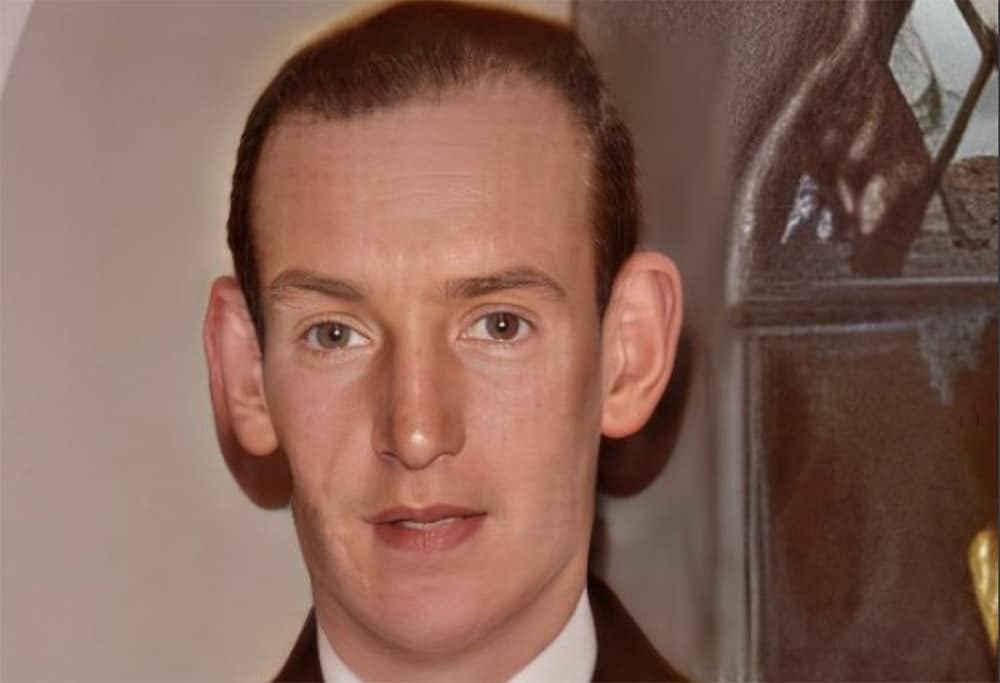
The family of Bertie Frazer who was murdered in 1975 have received a Police Ombudsman report which concludes that the RUC investigation into his death failed them and which calls the level of available archive material “a stark example of limited police record management.”
Despite the absence of significant records, the report to the family stresses concern about aspects of the investigation, including the junior rank of the officer leading the murder investigation, witness and suspect strategies, the disposal of a murder weapon and the lack of engagement with the Frazer family.
Bertie Frazer was shot dead on August 30, 1975 as he was leaving a farm where he often worked for a neighbour near Whitecross.
Mr Frazer, a council worker and part-time member of the Ulster Defence Regiment (UDR) was 47 and married with ten children at the time of his murder.
While reversing his car, a Hillman Avenger, out of the farm’s driveway, two men approached the car and shot him. The gunmen then pulled him from the driver’s seat and left him at the side of road before driving off in his car. He was found a short time later and taken to Daisy Hill hospital where he was subsequently pronounced dead.
The ‘South Armagh Republican Action Force’, a South Armagh Provisional Irish Republican Army (PIRA) unit, claimed responsibility for Mr Frazer’s murder, stating that it was in retaliation for the murders of two men, Sean Farmer and Colm McCartney. Mr Farmer and Mr McCartney had been shot dead at an illegal vehicle checkpoint near Newtownhamilton, a week earlier, on 24 August 1975.
Noone has ever been prosecuted for Mr Frazer’s murder.
Mr Frazer’s family received a report today (Thursday 5 February) from the Police Ombudsman’s Office detailing conclusions made by the former Police Ombudsman, Mrs Marie Anderson, before her retirement on 31 December 2025.
Initial police response
Mrs Anderson concluded that the initial police response to the murder was “prompt and reflected the standards of the day”. Police officers from Bessbrook and detectives from Newry attended the scene alongside specialist staff, including Scenes of Crime Officers (SOCO), photography and mapping teams. The scene was searched that evening and again the following morning. Two discharged 9mm cartridge cases were recovered and the primary witness who was in the farmhouse at the time of the murder was interviewed.
An Garda Síochána at Dundalk were informed of the murder and a military helicopter was tasked, which followed a car thought to be Mr Frazer’s for some time before losing sight of it.
However, the former Police Ombudsman also stressed that the relevant archived RUC material obtained as part of the investigation, was limited in scope and detail, providing only a partial account of the circumstances surrounding the murder and the subsequent police investigation.
While acknowledging the challenges of investigating complaints about historical matters due to the passage of time and unavailability of relevant witnesses and documentation, Mrs Anderson called it “a stark example of limited police record management”.
Missing records
The available RUC investigation papers did not include records of house‑to‑house enquiries or any house searches which may have taken place and there was no information relating to enquiries being made along the likely routes taken by the gunmen to and from the murder scene.
Witness statements were limited and, although three people were arrested following the murder, there were no messages, conference notes or any other documentation that indicated why individuals were considered suspects. Documentation relating to the arrests, such as custody records or interview records were not among the archived material. All three were released without charge.
There were no notebooks or journals for police officers and no record of investigative actions taken or allocated.
Police Ombudsman investigators could not locate any policy records to establish the rationale for decisions and actions in relation to witness, suspect and arrest strategies.
The absence of documentation made it difficult to assess the extent of local enquiries undertaken or to determine whether potential witnesses or evidential opportunities were fully explored. However, it appears key lines of enquiry were not pursued.
Witness Enquiries
Eleven witness statements were available in the archived material. All, with the exception of the statement from the primary witness to the murder, were from police officers, medical or forensic staff.
Although there was no evidence of a witness strategy and an absence of witness statements or records relating to witnesses viewing photographs or photofit images, the Police Ombudsman was satisfied that police investigating the murder did speak with three witnesses.
This addressed one of the Frazer family’s concerns which centred on whether men who came across the murder scene and saw the gunmen dragging Mr Frazer from his car, had been interviewed by police.
Two of the three men who witnessed the immediate aftermath of the murder were subsequently interviewed by Police Ombudsman investigators. They both confirmed that they had met with police, one making a formal statement at that time and the other confirming that he had provided a verbal account of what had happened and also viewed photographs.
Another man, who passed Mr Frazer’s car being driven by someone he did not recognise, and suspecting it had been stolen, went to the farm to alert Mr Frazer, was also identified as a witness. He found Mr Frazer at the side of the road and went on to contact the emergency services.
This witness was also interviewed by Police Ombudsman investigators and stated that while he was never asked to make a statement, he did meet a detective and was taken to view three suspects at Bessbrook police station. He did not recognise any of the three as the man he had seen driving Mr Frazer’s car.
Weapon Disposal
The spent cartridges recovered from the scene of Mr Frazer’s murder were examined and determined to be from a 9mm sub machine gun which had been one of the weapons used in the 1974 murders of two members of the security forces.
This weapon was subsequently recovered at Camlough, County Armagh, in June 1976 and in December the following year, a RUC Chief Superintendent signed a disposal form for the same sub machine gun. Police Ombudsman investigators found no further information about the weapon and efforts to establish what became of it proved unsuccessful.
The former Police Ombudsman reiterated her view that the disposal of weapons linked to unsolved murders and other serious crimes ought not to have occurred. Mrs Anderson remained critical of the blanket policy approach to the destruction of weapons used in unsolved crimes, removing the opportunity for police today, utilising improved technology, to re-examine weapons and identify and recover evidence that would not have been available to them in 1975.
Police knowledge of illegal vehicle check point and newspaper reporting following the murders of Sean Farmer and Colm McCartney
The family expressed a number of concerns about the actions of police officers in an RUC patrol car which had been stopped by an illegal vehicle check point shortly before the murders of Sean Farmer and Colm McCartney. The family believed that had the officers taken action, the murders of Mr Farmer and Mr McCartney would not have taken place and as a result, the retaliatory murder of Mr Frazer would not have happened.
Police Ombudsman investigators reviewed the statement made by the police officer in charge of the patrol who was in the patrol car at the time. He confirmed that he and two reserve constables, who had only recently joined the RUC, were in a ‘private hire’ car when they were stopped close to the border at an ‘army’ checkpoint at approximately 10.45pm on 24 August 1975.
He stated he was unaware of any planned military patrols taking place in the area, knew all the local UDR members and did not recognise the ‘soldiers’ at the checkpoint. He also stated that the ‘soldier’ who approached him had long hair, was wearing a ‘blacked-out’ cap badge and did not have a South Armagh accent. This, together with the fact that he saw no military vehicles, made him suspicious.
After the patrol car had driven away from the checkpoint and in the absence of a police car radio, the officer in charge used his handheld radio to make a transmission to Newry RUC control room. He also briefed An Garda Síochána and the army stationed at Newtownhamilton RUC Station. He stated that the army did not deploy as they required permission from Army Brigade Headquarters.
At 11:30pm that evening he received a 999 call from a member of the public stating that he had found two bodies near the location of the vehicle checkpoint. These were confirmed to be the bodies of Mr Farmer and Mr McCartney.
The police officer spoke with the PSNI’s Historical Enquiries Team (HET) in 2006, explaining that he was with two young, inexperienced police officers, a rifle was being pointed at them and he was aware that there could have been more ‘soldiers’ that he had not seen.
He believed that any challenge at the time could have resulted in the police officers’ being shot and that he could not fire his weapon from the car across the driver and without knowing who else was present outside.
It cannot be stated that if the security forces had taken a different course of action, the murders of Mr Farmer and Mr McCartney would have been prevented or that Mr Frazer’s murder would not have occurred.
The Frazer family also expressed concern about newspaper articles published in the wake of the murders of Mr Farmer and Mr McCartney which they believed may have increased the threat against UDR members and contributed directly to the murder of Mr Frazer.
In the articles, the then local SDLP councillor, Mr Seamus Mallon, stated he had “firm evidence” that a UDR patrol with blacked out cap badges and carrying weapons had performed a vehicle checkpoint in the area. The family believed that the evidence referred to had come from a police officer.
Police Ombudsman investigators spoke with Mr Mallon who confirmed that the information he referenced was told to him by a friend, who was a senior police officer. He named the officer, who was deceased.
The investigation found no evidence that police spoke with Mr Mallon to establish the origins of his information. It would have been a reasonable and appropriate line of enquiry for the officers investigating the murder to establish how, or from who, Mr Mallon obtained this information.
Rank of the RUC officer leading the murder investigation
An examination of the available RUC investigation papers established that a Detective Constable led the murder investigation. The former Police Ombudsman concluded that a more senior and experienced police officer should have been appointed to lead the RUC investigation, and that such involvement may have brought additional investigative expertise to bear on the case. Such experience could potentially have influenced the direction and outcome of the investigation.
Engagement with the family
The lack of engagement by police with the Frazer family was also one of the concerns raised with the Police Ombudsman and is a systemic issue identified in many other cases.
Although the modern concept of family liaison had not been established until decades after Mr Frazer’s murder, the Police Ombudsman concluded that there was “clear value” to be had in engaging with close family members as witnesses, who could have provided important information to detectives investigating the murder and that this would have represented a reasonable investigation action.
Mr Frazer’s car
Police Ombudsman investigators were also unable to establish what happened to Mr Frazer’s car, a Hillman Avenger. In the days following the murder, two reports were received by police about the same make of car. One stated that a Hillman Avenger had been burnt out in a certain location, and one stated that the car had been seen in another location. The family itself believes that a relative had made a report to a police officer at Newtownhamilton RUC station about Mr Frazer’s car being stored in a shed.
Police Ombudsman investigators spoke with the police officer named by the family. Although he remembered the murder of Mr Frazer, he could not recall being provided with the information. As the ‘Occurrences and Report Register’ from the station could not be located, the investigation did not have access to the police records of that time.
Conclusion
The former Police Ombudsman stated that Mr Frazer was a victim of sectarian violence and PIRA alone was responsible for his murder, concluding that, from the failings identified, the Mr Frazer’s family were failed by the RUC investigation into his murder.
Impact of Legacy Act on Police Ombudsman investigation
Investigative actions related to a number of allegations made by the Frazer family were not completed prior to the 30 April 2024, the point at which the Police Ombudsman ceased to have the power to investigate Troubles-related historical investigations.
Responding to. the report, Assistant Chief Constable Anthony McNally, Justice Branch, said: “Bertie Frazer was an innocent father of nine children murdered in a sickening, sectarian attack.
“The pain of such a devastating loss does not fade and my thoughts today are with the Frazer family who I met recently with the Chief Constable.
“We will take time to study the findings of this report which highlights the investigative failures, poor record management and a lack of engagement with Mr Frazer’s family by police.
“Policing has developed enormously over the past 50 years and the Police Service of Northern Ireland has greatly improved policies and procedures which guide how we approach criminal investigations today.
“Intelligence handling, training and investigative standards for detectives, forensic opportunities and family liaison processes today are unrecognisable from what were in place at the time of this terrible murder.”