Decisions on the controversial Drumcree parade must be guided by human rights law and a careful balancing of the rights of marchers, residents and counter‑protesters, two leading organisations have said ahead of fresh court proceedings on Monday.
In a joint statement issued on Monday, the International Federation for Human Rights (FIDH) and Belfast‑based Committee on the Administration of Justice (CAJ) said the authorities “must balance the rights to peaceful assembly of both Protestant loyal order marchers and counter-protestors while safeguarding the rights of residents to freedom from sectarian harassment”.
“Any restrictions on assemblies must be lawful, necessary and proportionate,” the organisations added. “With further court proceedings scheduled for Monday, a transparent and rights-based approach is essential to prevent further escalation.”
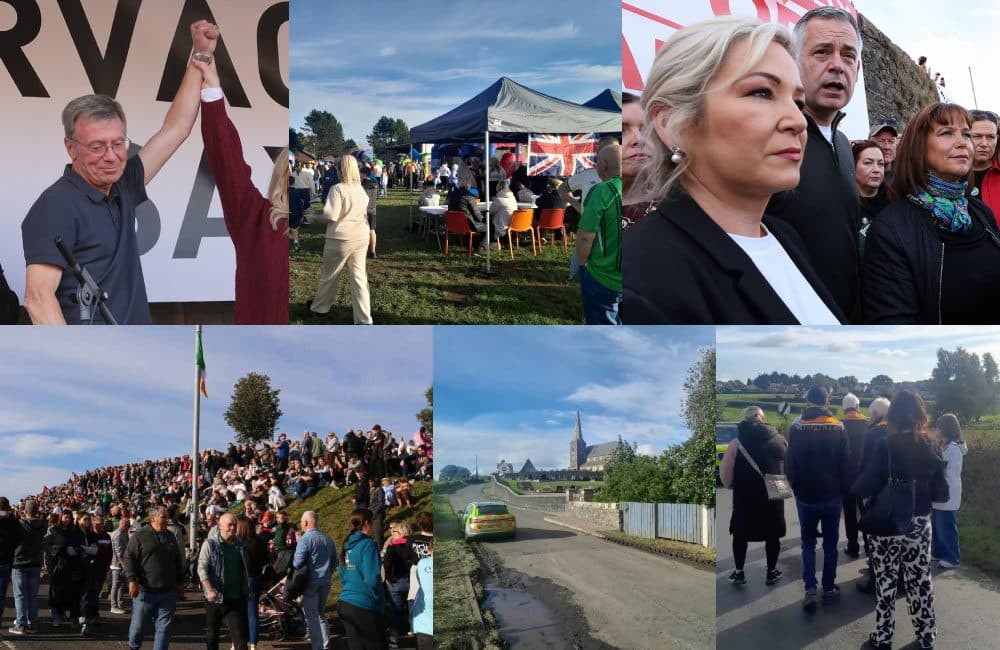
The intervention comes after the Parades Commission last week authorised a limited Orange Order parade along Portadown’s Garvaghy Road for the first time in 28 years – a decision delivered just 42 hours before the planned march.
A High Court injunction sought by residents initially delayed the parade, but that ruling was overturned by the Court of Appeal in the early hours of the morning. In the end, the parade did not proceed after the PSNI decided it would be disproportionate to use force to clear an estimated 1,000 or more counter‑protesters from the road.
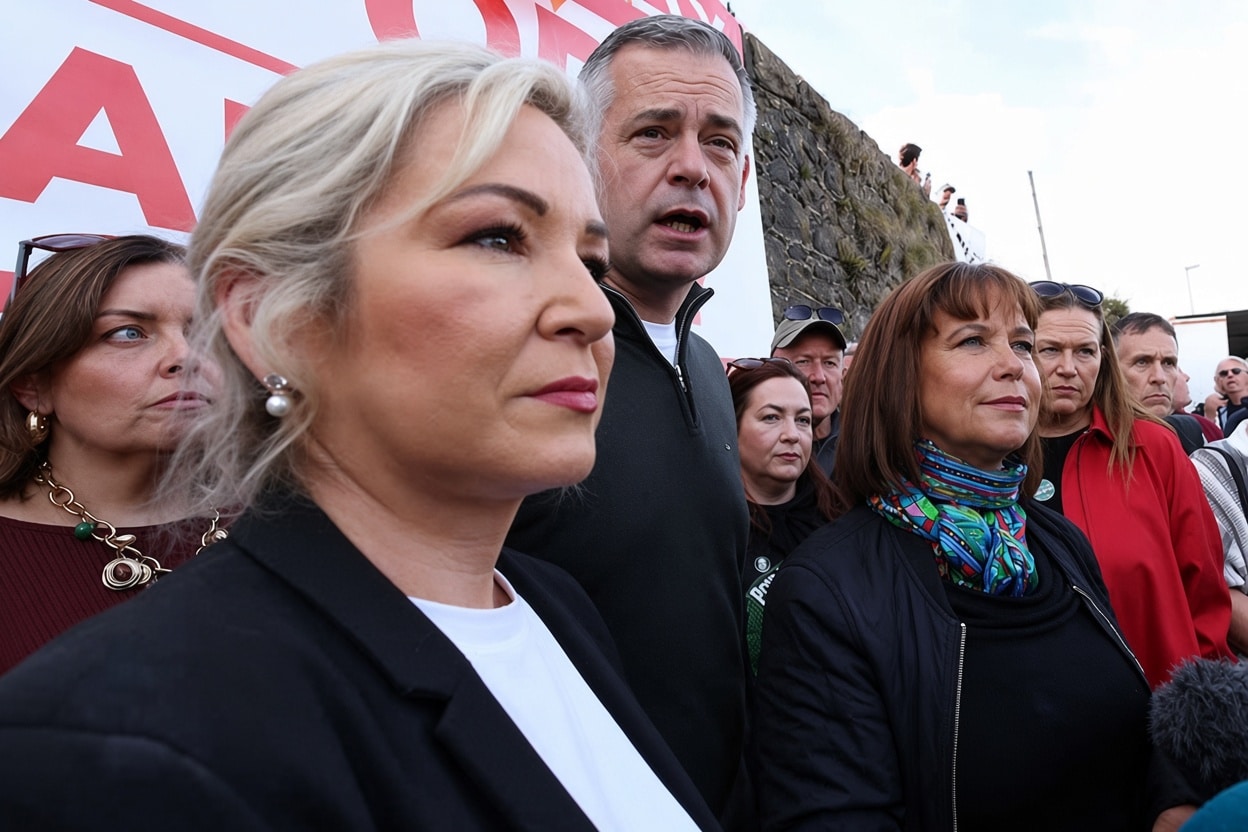
Sinn Féin’s Michelle O’Neill and Mary Lou McDonald address crowds and media who attended the Garvaghy Road Solidarity Rally on Sunday
FIDH and CAJ said the current dispute must be seen in the context of the Drumcree crises of the 1990s, when summer stand‑offs “repeatedly threatened to collapse the peace process”, with soldiers and police used to forcibly remove protesters in 1996 and 1997.
After the establishment of the Parades Commission, and the Drumcree‑linked murder of three Catholic children by loyalist paramilitaries in 1998, the annual Drumcree march was re‑routed along a parallel road and has not passed down Garvaghy Road for 28 years.
The groups stressed that under the European Convention on Human Rights, authorities have a duty to balance competing rights, including freedom of peaceful assembly and the rights of others.
They pointed out that there have been “long‑standing recommendations” for the “right to freedom from sectarian harassment” – referenced in the Good Friday Agreement – to be explicitly built into how parading disputes are decided.
“Freedom of assembly is a fundamental right for both those who parade and counter protestors. Where necessary in a democratic society it can be proportionately restricted to protect the rights of others,” said Daniel Holder, Vice‑President of FIDH and Director of CAJ.
“The Parades Commission decision did not properly consider that the Drumcree parade was inevitably going to require balancing two competing rights of assembly, nor is there consideration of the risks of sectarian intimidation.
“Transparency and a human rights-based approach across all relevant issues are essential for future decisions.”
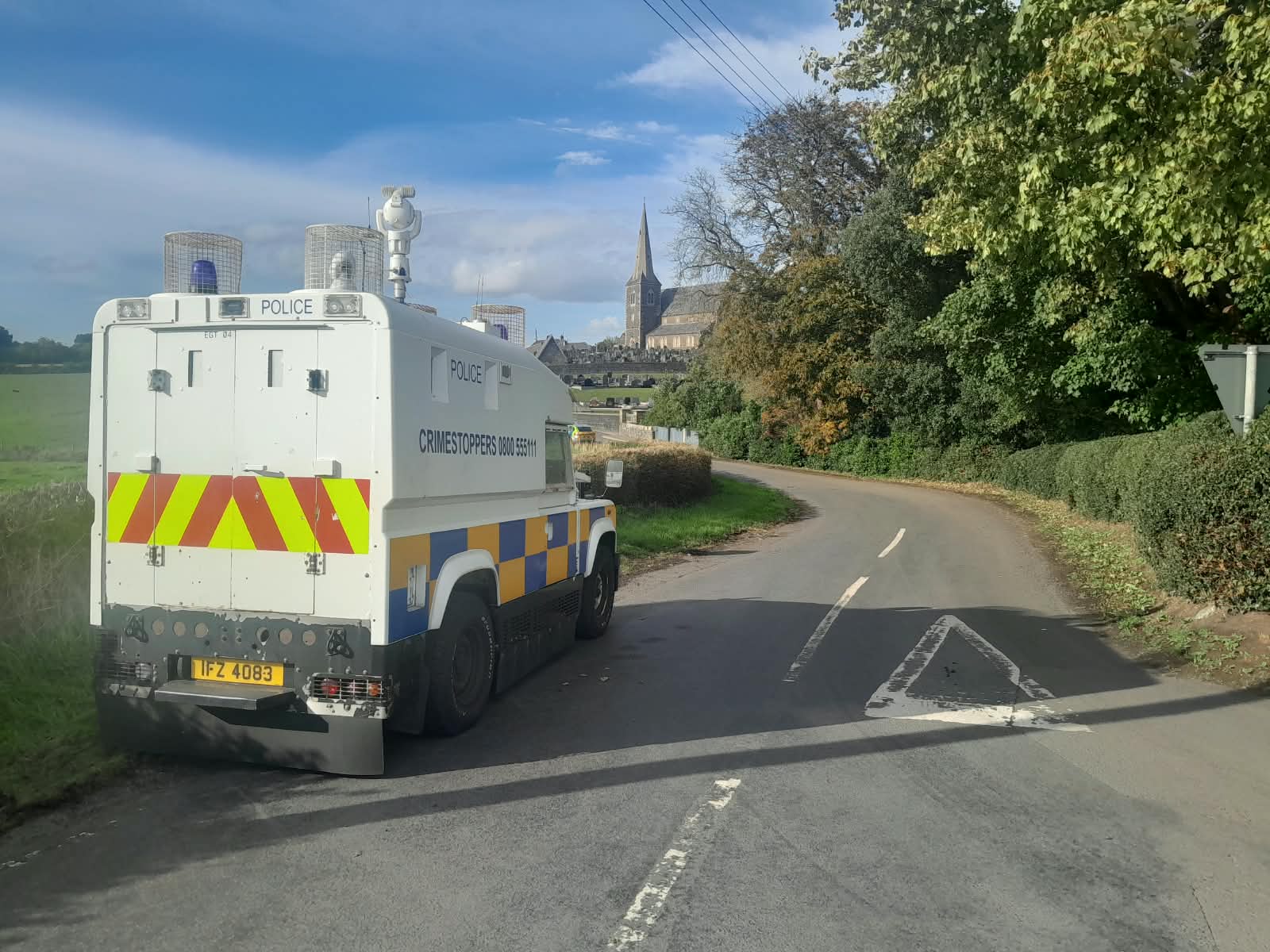
The statement notes that, to date, “all assemblies have been peaceful and there has been no use of force by the police”.
However, the organisations voiced concern at what they described as “the continued discourse of ‘illegality’ being applied to counter-protestors”.
They said a notification for 5,000 counter‑protesters had in fact been submitted in advance of last week’s events and was only stood down after the original High Court injunction was granted.
The groups also highlighted case law from the European Court of Human Rights indicating that, in some circumstances, the right to hold spontaneous, peaceful protests in immediate response to events – where a demonstration would be “pointless if delayed” – can override prior‑notification requirements.
“As the courts consider the case on Monday, the organisations stress that the protection of human rights must remain at the centre of any resolution to the Drumcree dispute,” the statement concluded.