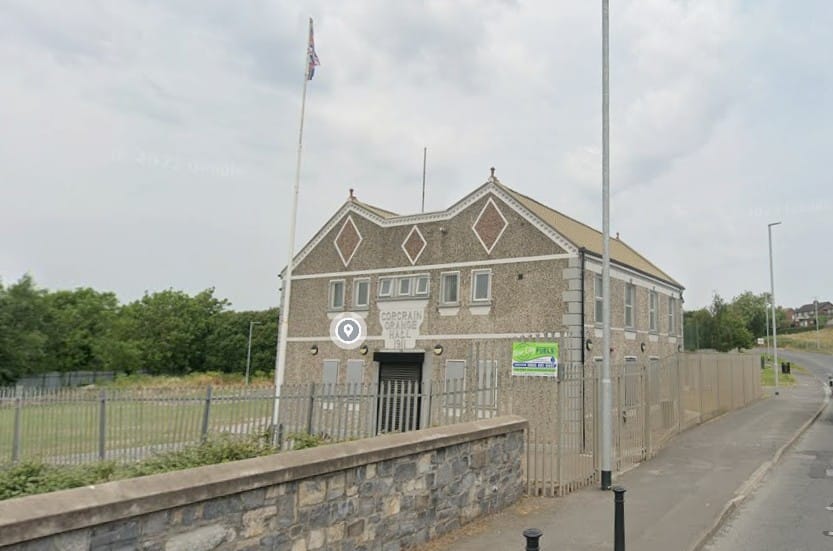
Plans to erect English-Irish street signs at Corcrain Gardens and Ballyoran Hill in Portadown have been approved by ABC Council – despite strong opposition from local loyal orders and community groups using Corcrain Orange Hall.
Councillors on the Planning Committee voted 7–5 in favour of dual-language signage for both streets using their discretion under the council’s policy after residents narrowly met the required support threshold.
Surveys carried out by the council showed 12 of 16 householders in Corcrain Gardens backing bilingual signs – just above the two‑thirds majority of 10.66 required – while 25 of 35 residents in Ballyoran Hill supported the move, exceeding the 23.33 threshold.
Before the meeting, officers and members of Reformation Defenders RBP 1517, who meet in Corcrain Orange Hall, wrote to ABC Council urging councillors to reject the applications.
They said they had chosen Corcrain as a meeting place because of the “now peaceful atmosphere” and that older members “now felt safe entering an area where once they would have felt unsafe”.
The preceptory argued that the Corcrain/Ballyoran district had become a “truly shared space after decades of division and violence”, and warned that bilingual street signs would “destroy the excellent community relations in this now shared space”.
Their correspondence described dual-language English/Irish signs as “an attempt to mark territory and to claim it as Irish”, adding that English-only signage could be read “by everyone in our community without feeling intimidated or threatened, unlike with Irish signage”.
The letter claimed the minority Protestant community in Corcrain had been “decimated by families being intimidated and threatened out of the area” and argued that dual-language signs would send a message that “Protestants and unionists are no longer welcome”.
The Worshipful Master of RBP 141 raised similar objections, saying his preceptory believed the signs were “divisive, with the motive being to make Protestants/unionists/loyalists feel unwelcome in the area, in the hope they will stay away”.
He said such moves were “not the way to build community cohesion” and would only “build tension in an area that has been fairly peaceful for quite some time now”, also describing the spending on signs as “unnecessary expenditure” at a time of budget pressure.
Corcrain Cultural and Development Association and Corcrain Purple Rocket LOL 339 lodged separate objections along similar lines, citing fears over community relations, marking territory, and the removal of the nearby peace fence as already unsettling the area.
During the committee meeting, Sinn Féin councillor Paul Duffy (Portadown DEA) questioned why the late objections were being given any particular weight.
Head of Building Control, Tom Lavery, said officers were required to present “all information in relation to this” and that it was “for members to decide as to how much weight they put on these objections or any other comments that come forward”.
Cllr Duffy dismissed cost concerns raised by objectors, stating that the council was “duty‑bound” to cover signage costs where applications met policy, and that residents seeking bilingual signs were ratepayers “legally entitled to apply”.
“I think that anyone reading these objections does not take long to conclude that they are based on intolerance,” he said.
“We are not looking to do away with the English language signage here. It is just blatant anti-Irish [sentiment].”
He later highlighted the council’s legal defeat over a previous decision to refuse bilingual signs at Woodside Hill, saying court proceedings had already cost the authority “in the region of £90,000‑odd” and warning that repeating such refusals risked further expensive challenges.
Alliance councillor Peter Lavery (Lurgan DEA) said he found the objections “a wee bit disappointing”, particularly the language around “marking territory”.
He stressed that the dual-language street signage policy had been “agreed by all 41 elected members from all parties in this chamber” and had been in place for several years.
“There seems to be some concern amongst the objectors that you might end up in a situation where you have a language sign in English and Irish beside a Loyal Orange Order Lodge,” he said.
“Personally, I do not have concerns about that, because I feel that that kind of cultural diversity in that area is reflective of the cultural diversity in that street, in Portadown and in this borough.
“I think we should be proud of the cultural diversity we have — it is an asset to us. I do not see this as a zero-sum game where doing something for one particular group means another suffers.”
On Corcrain Gardens, Cllr Lavery said residents’ wishes had to be central: “My own view is that this has clearly met the policy. The residents have made their views clear.”
In relation to Ballyoran Hill, he pointed out that 25 of 35 residents – 71 per cent – had backed bilingual signs, again meeting the policy threshold.
He described the earlier Woodside Hill case as “the cost of division” and “the cost of discrimination”, warning colleagues not to repeat decisions that could be overturned in court.
“I would encourage people to have a more open mindset here in this council in terms of these applications. Where it meets the policy, it’s approved,” he said. “This has met the policy, and I place overriding weighting on the views of the residents.”
Committee vice-chair, Sinn Féin councillor Mary O’Dowd (Lurgan DEA), said objections to Irish-language signage were “quite shameful”.
“A language is for everyone, not just one religion or one race or one whatever. Irish is open to everyone,” she said.
“I have three children who speak it and I am very proud they speak it. But for people who think it is offensive — that is on them.”
DUP councillor Kyle Moutray (Portadown DEA) urged colleagues to consider “the historical context of the area” and the concerns of the objectors.
Referencing legal advice around the policy, he said councillors were required to take into account “other lawful considerations” when exercising their discretion.
“We have seen these three objections and they give us an insight into the historical context of the area — an area in which this Orange hall exists — and the groups within it,” he said.
“This is an Orange hall that has been here for over a century. Through that time, and more recently, there has been relative stability and a sense of peace.
“I think they have genuine concerns that they do not want anything to heighten tensions. They feel this has the potential for that, and that it could contribute to a sense of alienation and tension within the local community. So, I have to apply weight to that.”
On Ballyoran Hill, Cllr Moutray again cited a 2014 court case which, he said, allowed decision‑makers to “give weight to other views” beyond simple percentage thresholds.
He said the objections from the Orange lodge, cultural and development association and two Black preceptories all argued that bilingual signs would be “detrimental to community relations”, adding: “I do have genuine concern for how this could contribute to a sense of alienation within that community.”
Responding to those points, Cllr Peter Lavery said: “We should not let the divisions of the past hold us back from making things better for the future.
“I think Cllr Moutray pointed out that the Orange hall has been there for 100 years, and I think the decision today would simply mean it will still be there for another 100 or more years, but just with a street beside it that has a sign in English and in Irish.”
He argued that recognising residents’ wishes under an agreed policy did not undermine the presence or rights of any community group.
For Corcrain Gardens, Cllr Duffy proposed that councillors use their discretion to approve English-Irish signage, with Cllr Lavery seconding.
A recorded vote saw seven councillors support the proposal: Cllr Kevin Savage (SF), Cllr Mary O’Dowd (SF), Cllr Fergal Donnelly (SF), Cllr Paul Duffy (SF), Cllr Peter Lavery (Alliance), Cllr Sorchá McGeown (SF) and Cllr John Óg O’Kane (SF).
Five voted against: Cllr Scott Armstrong (DUP), Cllr Julie Flaherty (UUP), Cllr Kyle Moutray (DUP), Ald Paul Rankin (DUP) and Cllr Ian Wilson (DUP).
With seven votes to five, the recommendation to approve bilingual signs at Corcrain Gardens was adopted.
The subsequent debate on Ballyoran Hill mirrored the earlier discussion, with the same balance between residents’ support and objections from loyal orders and community groups.
Cllr Lavery again proposed approval, seconded by Cllr Duffy. A recorded vote produced an identical outcome: seven in favour and five against.
With that, the committee agreed to support English-Irish street signs at both Corcrain Gardens and Ballyoran Hill.