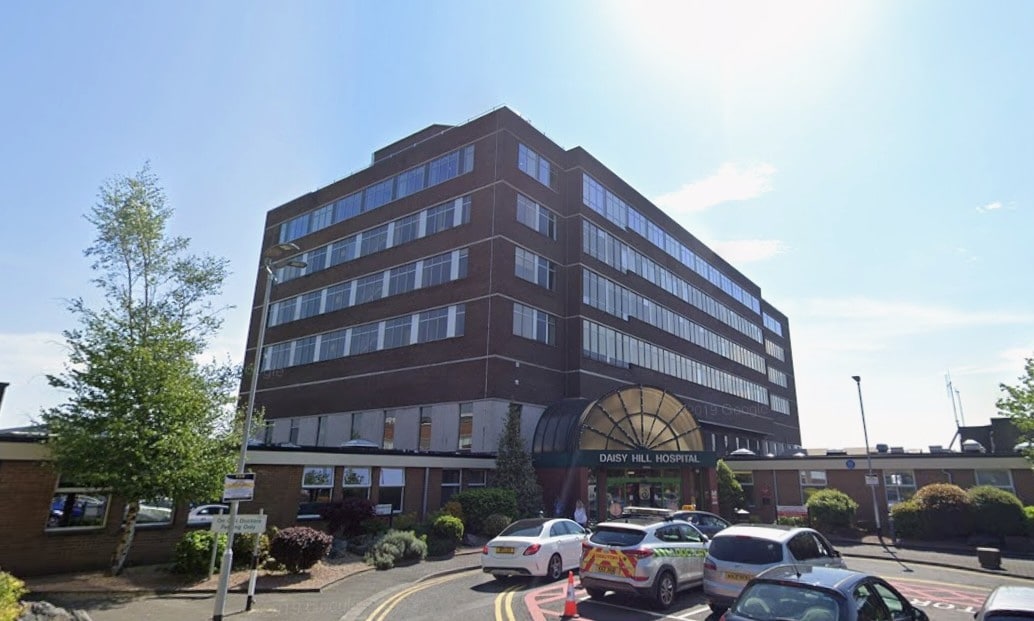
The Southern Health Trust says it will “actively seek to recruit” staff to restore maternity services at Daisy Hill Hospital, but admits it cannot say when labour, births and inpatient maternity care will return.
The chief executive of the Southern HSC Trust, Steve Spoerry has reaffirmed the health body’s strong commitment to safeguarding the future of the Newry hospital.
Treatments currently unavailable at Daisy Hill Hospital include all labour and birthing services, inpatient maternity care and emergency gynaecology support. These services have now moved to Craigavon Area Hospital.
Speaking at Thursday’s (November 26) board meeting of the Southern HSC Trust, Mr Spoerry was anxious to address a range of concerns expressed at the start of the session by Newry & Armagh SDLP MLA, Justin McNulty.
The senior Trust figure commented: “I personally and the board collectively realise the extent to which this has worried and angered people in and around Newry who use Daisy Hill services.
“I want to be very clear, we’re not giving up on Daisy Hill, we’re not giving up on Daisy Hill Obstetrics. We will in the coming months actively seek to recruit and we will report on how much progress we make.
“We’re also definitely not giving up on Daisy Hill as a hospital. Daisy Hill has been doing very well. Ironically, before this particular issue came up, we were thinking about how to build on the stability we have achieved. We still want to do that.
“In relation to recruitment, the Trust is either just starting or about to start active recruitment. We want to recruit to Daisy Hill. Obviously, we need to explain that the initial base [for new staff] will be Craigavon, but we would like to appoint people where the intention is that they move to Daisy Hill as we establish the team.
“The Department of Health has committed to undertaking a Northern Ireland recruitment campaign internationally seeking obstetricians, with a particular focus on Daisy Hill and Newry.
“We believe that we have acted lawfully. This was not a planned service change. It was a service change where we were reacting to the loss of staff. There’s due to be a judicial hearing in early December. We will see what the judge decides.
“We wrote to every consultant obstetrician in Northern Ireland asking if they would come and work with Daisy Hill and to take on additional work, and offering a generous remuneration.
“We did receive two indications of interest, but we didn’t get enough indicators of interest to construct a viable roaster. So, we needed more time [to recruit] more people to make the roaster safe.
“We will have a clear plan that sets out recruitment initiatives and the criteria that have to be met for the restoration of the service at Daisy Hill. What we can’t give is a timetable for that, because it’s dependent upon our ability to recruit.
“If we were in a lovely situation and then, for the sake of argument, several obstetricians from another country responded to our recruitment advertisements, they could arrive in May and after some induction training they’d be ready to go in September. That would be lovely, but we don’t know that at the moment.”
Trust deputy chief executive, Colm McCafferty echoed Mr Spoerry’s sense of disappointment that temporary closure of maternity services could not be averted at Daisy Hill Hospital.
He told the Newry & Armagh MLA: “As the director responsible for the service, this is not a space I want to be in. This has been all consuming for the past number of months. We find ourselves in this position out of necessity, the well-versed deficits and shortages in consultant cover in Daisy Hill Hospital.
“Our preferred choice is to have a two-site maternity in-patient model, but that is not sustainable at this moment in time, hence our temporary consolidation from Monday past.
“Since the consolidation [of the service] on November 23, 21 new babies have been welcomed into this world, including 13 via elective C-sections. My thanks to medical colleagues who ensured that there was C-section activity on Monday despite the industrial action, and I think that is indicative of a commitment to women.
“It’s been busy. There’s a significant increase not only in the babies being delivered, but in the amount of staff now located on the Craigavon site. The theatres by and large have worked very well and there’s been good planning, really good collaboration.
“I do want to emphasise that there is no change to gynae outpatient or inpatient care in Daisy Hill Hospital. That whole programme continues. There is a change to emergency gynae and that’s it. And that is a very small number of cases.
“I acknowledge the huge change in terms of practical change but also the emotional impact on long-standing dedicated maternity staff on the Daisy Hill Hospital site, and I want to acknowledge the very collaborative approach and engagement with staff, despite the highly-charged emotions and so forth with regards to it.
“And I also want to thank the very constructive and challenging role that staff side organisations have played in helping us shape [new] pathways during this temporary consolidation.
“We have all the required staff in place. On Monday there had been considerable trepidation [and] everybody who was supposed to turn up did turn up. It’s a credit to everybody.
“I’ll briefly outline the critical pathways that we have been working on, the ED (Emergency Department) pathway for O&G (Obstetrics and Gynaecology) engagement with Emergency Department colleagues in Daisy Hill.
“It’s important to emphasise this is for the very small number, albeit very high-risk presentations, whether it’s emergency gynae or emergency obstetrics. This has been the pathway that has challenged us most across the board because it is difficult to provide confidence and reassurance with regards to it in terms of the medical input, the ED responsibilities and the midwifery role in terms of supporting that pathway.
“We continue to engage extensively with staff side colleagues and all other interested parties in relation to continuing to refine and develop that. We have the pathway operational and up and running with the required medical cover and the required midwifery cover since implementation on Monday.
“We have a number of experienced lead midwives who have agreed to make themselves available should an emergency present at Daisy Hill Hospital, and that is how we plan to move forward with regards to that.
“We have retained the Special Care Baby Unit in Daisy Hill, and we will work in terms of monitoring data because there will be some cross-site transfer of babies and mummies during that process.
“The other critical engagement has been with the Northern Ireland Ambulance Service (NIAS). And again, I do want to acknowledge the very supportive approach from NIAS colleagues.
“We are confident that we have been able to develop sufficient ward and theatre capacity, albeit there will continue to be a bit of estates works. Even when this is finished and we go back into a two-site model, which is our clear intention, the estates work will be for the betterment of Craigavon moving forward anyhow.
“The other work stream I’ve been very involved in is engagement with our Lady of Lourdes Hospital in Drogheda. There’s been questions asked about the potential of getting cross-border consultant cover. We did approach that and that was simply not a viable option.
“Whether there’s something more sophisticated that can be done at a political and both Departments of Health level, let’s wait and see, but that’s not something that as a Trust alone we’re able to progress.
“What we are able to progress is a cross-border pathway, and I can report really constructive senior management engagement on a weekly basis between Drogheda and ourselves with regards to that.
“In terms of communication, I can advise that as from two weeks ago, across the entire Trust, every single woman due to give birth up until the end of February has had individual conversations with their midwives to address any anxieties.
“Our commitment is to exhaust every viable opportunity to reinstate services. We will be retaining the Daisy Hill footprint to ensure that there are no physical barriers to reinstatement, if and when we get to that position.”