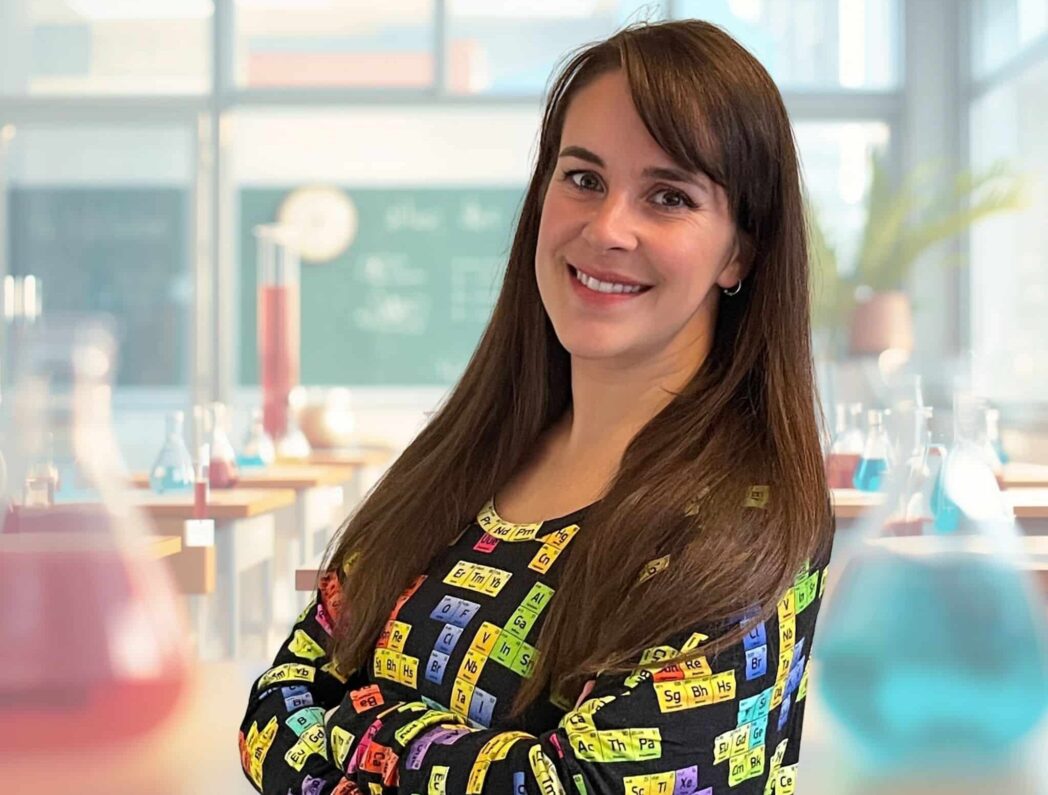
A Newry-based chemistry teacher has proven she has all the ‘elements’ for excellence after being recognised by one of the UK’s oldest and most valued institutions.
Elise Bulow, who lives in Portadown and is head of department at Newry High School, is one of only three winners of the annual Salters-Horners teaching awards – two of which actually came to Northern Ireland.
A charity, founded in the early 14th Century, Salters-Horners is up there alongside the Royal Society of Chemistry, in terms of reputation, recognition and respect.
For Elise – who is originally from Canada – she has always been a great supporter of the organisation. But never, ever did she imagine in her wildest dreams that she would be recognised in such a way.
She told Armagh I : “They’re quite a prestigious charity and they do loads of work all year, like promoting chemistry and funding different activities and stuff for chemistry teachers to avail of as well as students. For example, I would go to their big Salters Festival of Chemistry at Queen’s University every year and I bring a group of Year 10s or year 11s to Queen’s and they participate in a whole free big day, where they get to work in the Queen’s University labs and pretend to be proper scientists all day and that’s all funded by Salters.
“I’ve always been in contact with their various events and stuff that was going on and I’m on the email chain for newsletters. As part of their monthly newsletter, they just did, ‘Are you a teacher in chemistry?’ and set out the criteria for these teacher awards. I glanced over the criteria and I’m like, wow, well, that’s everything that I work really hard at doing and that’s exactly what I stand for as a teacher and all of my efforts over the last 10 years have been focussed on exactly those areas.
“I just put it in the back of my mind and thought I’ll never get it, because it’s all of the UK and here’s me at Newry High School. I’ve been working for 10 years, but saying that, I got promoted to head of department really early on in my career and I definitely would be on the most passionate end of the spectrum in terms of teaching. So I talked to my principal about it. I showed him the award and asked do you think I’d have any chance if I threw my name in?
“He said, ‘absolutely Elise, I will definitely write a reference for you. You really should’. I had to fill out an application with five questions on how I met each of the five criteria and then my principal had to do the same and sent it off and I just did not think I would really hear anything back.
“I got invited to London for an interview in the Grand Salters Hall. I didn’t actually go to London though, because I felt bad using the charity money on a flight for me and parking and transport when the money could have been used to just help kids get into chemistry and science. So I actually asked to do it virtually instead and got it. The interview was about 45 minutes to an hour and she called me back the day of it and just said that they absolutely loved everything I had to say and, yeah, got the award.”
Mum-of-four Elise was “delighted” and, at the same time, “in shock” that she had been chosen.
Husband Daniel and her entire family – together with her pupils and colleagues – are thrilled that she has been honoured in such a way.
But for the Newry High School teacher, she always knew that her career path would take that scientific route.
“I’ve actually just poured my whole heart and soul into teaching for my entire career,” added Elise. “ I’ve always known I wanted to be a science teacher from I was 12 years old. I’d heard the calling and then pursued it with vigour, all throughout university and beyond.
“I made a conscious decision to work at Newry High School. I absolutely love working here and I love working with these pupils because, you know, all of the efforts that I put in, I can really see massive amounts of progress.
“It was just really, really nice and I was overwhelmingly thankful that a lot of that hard work was actually recognised.
“I’ve given up a lot of hobbies and other things that I could have done in the evenings. I’ve spent them designing really great lessons and thinking, how can I make this interesting and how can I get these kids involved? I’ve really sacrificed a lot in my personal life for my career, so it’s just really nice to be recognised.”
The excitement and enthusiasm for teaching and for chemistry in particular really comes across when speaking to Elise.
For her, it is more than a vocation, it is a path to engaging young minds, preparing them for the future and in a subject which holds all of the answers.
“What attracted me to chemistry and science in general is that it explains the world around us,” explained Elise. “I think science and chemistry is just the most amazing thing, because it can answer all the questions we have, from why does that look like that or why does this behave like this, or why is this person sick and all of the big, big questions in society, from how are we going to mitigate climate change to how are we going to fight this disease? All of those major questions.
“How are we going to clean up Lough Neagh? The answer lies within science and technology, obviously with the will of politicians in the world, but a lot of the actual practical solutions can be answered with science.
“ I just think of its role in society and just how I can foster curiosity. I am always totally blown away by scientific experiments and by what science can offer and how it’s conducted and all of the different real world applications that it has.”
Taking the possibilities and potential and putting them into the everyday practical is important.
For teaching chemistry and science subjects is not just about delivering texts verbatim. It’s about making the young people ask questions themselves and, often times, reaching their own conclusions.
Therein lies Elise’s gift in inspiring pupils and challeging them to think for themselves.
An infectious “passion and enthusiam” therefore is top of the ingredients for the recipe for what makes a good chemistry teacher in her own humble opinion.
Said Elise: “For science and chemistry specifically, it can be on the more challenging end of subjects for students because it can be a bit more abstract. Something that I do, day in and day out, every single day, is the practical element of it. It’s just so important. Nearly every class, the students are walking in and there’s some sort of experiment set up. There’s some demo. They’re always on their feet.
“ I do a lot of backwards kind of teaching, so I don’t actually teach it to them. I get them to figure it out. Just yesterday, I put an acid and an alkali on something and then put the indicator on and it’s different colours and then it’s changing colours in the middle and, before I’ve even talked to them about neutralisation, I’m getting them to try and figure it out.
“It’s to try and engage them with the curiosity and then to try and get them to use the critical thinking to try and answer what they see around them, which is essentially what a scientist does.
“I think a good chemistry teacher is definitely engaging in getting them to really use their brains. It’s not just about memorising facts, it’s about how you are able to perceive a problem and figure out the answer to it, because at the end of the day, I really just want to be making citizens that can try and solve problems that they encounter with a scientific brain, if they’re able to see something and be able to try and figure it out and work it out, rather than just be an apathetic member of society that doesn’t really think about much.”
Elise will now attend a presentation ceremony in December, when she will officially receive her Salters-Horners teachers award.
And, as part of that presentation, she will take home a cash prize to launch a project within the science department of Newry High School.
It will certainly be put to good use – and it will benefit all ages and abilities too in different ways.
“One of the issues, I think, facing a lot of young people is self-confidence and fitting in and just mental health overall,” added Elise. “ We would have quite a diverse group of pupils here, which is lovely and amazing and that’s why all the teachers that work in here, they stay, because we just love the kids that we have here and it’s never the same day twice.
“They’re not robots that come in and sit down and are completely silent. They have so much charisma and so much diversity and so much to offer. There are some that maybe don’t feel like they belong in certain groups. There’s s0me that aren’t athletic and there’s some that maybe don’t get involved.
“The project that we want to do is called ‘Science at Lunch’, where we would get a group of the GCSE, the Year 12s, as well as the A Level pupils in science, to run a programme and target a lot of the more vulnerable pupils in Key Stage 3 that just need a safe space to go for lunch and aren’t really involved in anything but could use a wee community at school to just feel like they belong a bit more.
“It’s to try and promote inclusivity and to try and promote student engagement and involvement, as well as upping science skills.
“For the other end, for the GCSE and A Level pupils, it really is a leadership building activity. They’re going to be, in conjunction with myself and maybe a few of the other science teachers, deciding on what programmes we are going to do at lunch.
“Something in the past we’ve done is asked, do having marshmallows make hot chocolate colder or warmer. A lot of people would think, they’re going to insulate it, but actually they absorb most of the heat. So putting marshmallows on hot chocolate actually makes the hot chocolate cool down much faster. It’s small little things like that you could do over a lunch period, and a lot of the kids coming, they just are excited for it because they always leave with a hot chocolate or they leave with something. They get a wee badge as well, so they feel part of something.
“But the older ones, we’re trying to get them to feel really confident in their practical skills, as well as engaging with the younger children to make them feel a bit more confident.
“We’re also trying to increase our uptake at Sixth Form. Because we’re a small school, we don’t have a lot of them going in post-16, so we’re really trying to get a lot of them to really gravitate towards STEM. So we’re hoping that it’ll increase our uptake post-16 and also just increase the kind of leadership skills and confidence of the older ones.
“It’s something nice to put on their UCAS as well and to build their CV too, so that’s something I’m really looking forward to launching next year.”