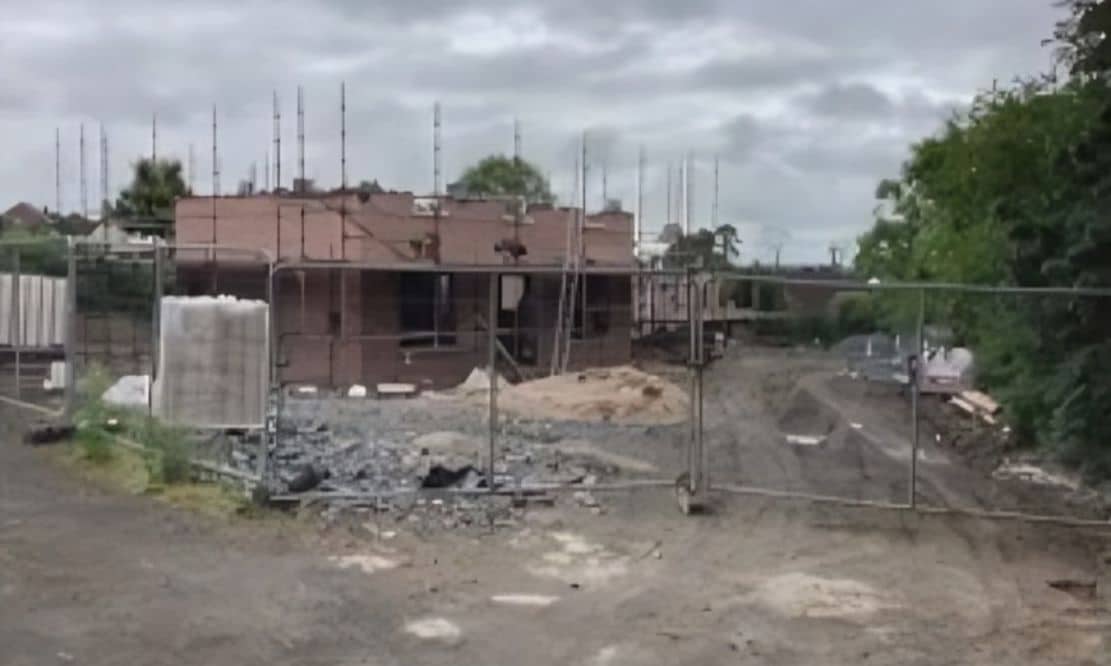
A property developer, who was seeking permission to build dwellings ahead of a method of sewage disposal being agreed by NI Water, or a consent to discharge being granted, has been refused such leeway.
Even though some of the houses are now partially constructed, ABC councillors expressed concerns, at the January 7 Planning & Regulatory Services committee meeting, that allowing such a development would open the floodgates for the construction of “ghost estates” where the sewage disposal issue hasn’t been formally settled.
The applicant, Waringstown Ltd, Church Square, Banbridge, was granted planning permission in April 2022 to build four dwellings and garages on a site 14 metres east of No 1 to 4 Church View, Banbridge Road, Waringstown.
The said developer was now seeking to amend the following condition attached to planning permission: “No development shall take place on-site until the method of sewage disposal has been agreed in writing with NI Water, or a consent to discharge has been granted under the terms of the Water (NI) Order 1999.”
The proposed amendment read as follows: “No dwelling shall be occupied until the method of sewage disposal has been agreed in writing with NI Water, or a consent to discharge has been granted under the terms of the Water (NI) Order 1999.”
Senior planning officer, Liam McCrum commented at the meeting: “The principle of development on this site for residential development has been accepted under [a previous] planning application, and this was for the erection of four dwellings subject to a number of planning conditions.
“Condition No 13 of planning approval was attached to ensure the protection to the aquatic environment, and to ascertain that a feasible method of sewage disposal would be available on the site.
“By commencing development on site, the applicant is in breach of this condition of the planning permission.
“This pre-commencement condition was used by officers (…) to help the applicant avoid unnecessary expense, before it could be ascertained that a feasible method of sewage disposal would be available, and also to ensure that new housing would not be partially built and left unfinished or unoccupied, due to a lack of sewage infrastructure.
“NI Water were consulted on this application, and noted that the receiving wastewater treatment works in Waringstown currently had no capacity, and that no new connections were likely to be approved in the lifespan of this application.
“In terms of consent to discharge, the applicant indicated that foul sewage disposal was to be managed via septic tanks. Consent to discharge is required from DAERA Water Management Unit to provide the said septic tanks.
“Water Management Unit has advised that private sewage treatment systems cannot be considered as an automatic alternative where a connection to NI Water infrastructure is constrained.
“The proliferation of individual septic tanks or small treatment plants, particularly in urban environments within established NI Water infrastructure, is not considered environmentally sustainable, and does not provide a long-term protection for future homeowners.
“To date, no complete application for a private wastewater treatment plant to serve the development has been received by Water Management Unit.
“In summary, a method of sewage disposal has not been agreed with NI Water, nor consent to discharge has been granted for the site from Water Management Unit.
“Officers, in consultation with Water Management Unit, are of the opinion that the condition should not be amended, and the original wording should remain.
“Officers consider that the development was carried out at risk by the developer and in breach of condition 13 of the previous planning permission.
“It is clear that no acceptable method of sewage disposal currently exists for the site, or that it will be forthcoming anytime soon.
“Officers consider the proposed amendment to condition 13 would set a precedent for the council on other similar planning applications, where capacity is not available to serve the housing developments within settlements.
“This could potentially result in adverse effects in the aquatic environment, and applicants incurring unnecessary expense before it can be ascertained if a feasible method of sewage disposal is actually available for a new housing development, and it being left unfinished/unoccupied due to a lack of sewage infrastructure.
“Officers therefore recommend that members agree with the recommendation to refuse.”
Committee chair, Councillor Kevin Savage (SF, Banbridge DEA) remarked: “If we were to discharge this condition, we could potentially end up with a blight of ghost estates throughout the area, with the houses built and no connection to sewage systems at all.”
Councillor Mary O’Dowd (SF, Lurgan DEA) concurred with her party colleague: “In my opinion, when someone breaches the conditions, they do so at their own risk, and I personally think that we can’t let something like this pass, because we would be opening the floodgates for everybody else to start building without following conditions.”
Councillor Scott Armstrong (DUP, Armagh DEA) was in agreement with what had just been said: “Yes, sort of along the same lines. It feels like somebody’s jumped the gun here.
“We can’t be letting that happen, [or else] we’ll see ghost estates built throughout the borough, which will cause more problems down the line. So, I think the officer’s recommendation is the correct one in this case.”
Councillor Peter Lavery (Alliance, Lurgan DEA) pointed out that planning rules were also designed to protect the environment and future residents: “I think we’re all in one mind on this. I don’t think approving this application is the right way to go.
“When we as a committee, or indeed planning officers, lay down conditions, those conditions have to be followed in every case in order to protect the environment, and to protect the future residents who would inhabit the dwellings, to make sure they’re not inheriting a nightmare situation or a legal case.
“I completely agree with the concerns that other members have raised, and I think refusal of this application is the right way to go. Developers need to ensure that they adhere to all of the conditions of their planning applications, or else they’ll end up like this.”
The recommendation to refuse to amend the wording of the condition attached to planning permission, was proposed by Cllr O’Dowd and seconded by Cllr Armstrong.