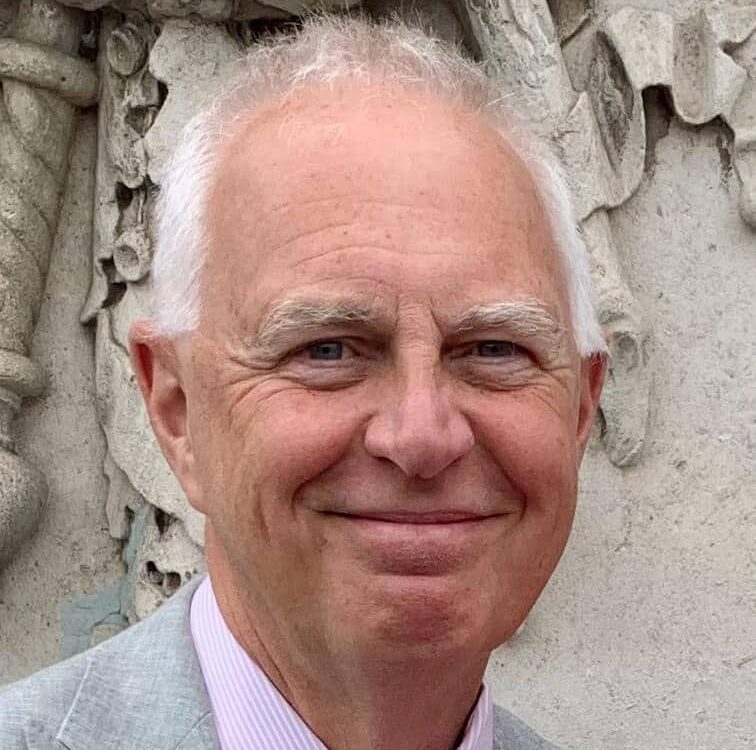
A GP at the heart of the local community and a community forever in his heart, Dr Robert Carlile has retired from Tynan Surgery after more than three decades of dedicated and diligent service.
As he stepped down last week, he leaves with fond memories and a deep gratitude for the warm welcome and friendship shown to he and his family since their arrival away back in the autumn of 1993.
When he and his wife, Pat, and sons Andrew and Simon, uprooted from their lives in Belfast to relocate to rural Tynan, he knew it was a huge decision to make.
But looking back, he – and they – have no regrets whatsoever.
“Tynan has really given me an awful lot,” Dr Carlile told Armagh I, as he reflected on many great years spent working there.
“We got a lifestyle that suited us and a patient population who were warm, welcoming and appreciative. Our kids got to go to good schools and have now moved on to the careers that they were looking for and are doing well in their careers.
“I think writing life plans is a bit of a lost cause because they tend to last for as long as it takes the ink to dry on the paper and, looking back, it would have been an extremely good plan if I could have thought about it at the start.”
Dr Carlile trained in Lisburn and his locum placements took him all across Northern Ireland, including Newtownhamilton in County Armagh and Lisnaskea in County Fermanagh.
His last posting before arriving in Tynan was at Dr Gerry Kelly’s surgery in Keady.
He explained “Dr Fitz Gillespie first contacted me to ask that I come to Tynan to work for a few weeks; in those pre-satnav days I had to consult a large-scale road atlas to find where I had just agreed to go to. As I drove down from my then home in Belfast, I did not realise that within a few weeks Fitz would offer me a partnership and I would go on to work for the best part of 33 years in Tynan Surgery.
“Fitz had told me it was actually Gerry (Kelly) who had passed my number to him and that’s how he got hold of me. In common with a lot of GP trainings, you could have a fairly lengthy period of doing locum, sort of wandering from practice to practice before a post came up, because in those days, even though the number of GPs in training in the north of Ireland was limited to 55 or 60, the number of posts that came up was relatively small, which is a complete reversal on what we’ve been experiencing over this last number of years where, despite the significant increase in numbers of GPs and training in the Province, it has been very difficult for practises to recruit. It’s sort of a mirror image of what it now is.”
Today, Dr Carlile lives outside Caledon, and he and his wife, Pat, have three grandchildren – and another on the way – with sons Andrew and Simon having married and settled, one in Belfast, the other in Germany.
Years after arriving in County Armagh and this tiny village of Tynan, his wife admitted asking herself at the time: ‘Where is he taking me too?’
But she gave up her post as a nurse in Belfast City Hospital and agreed to come and live in Caledon.
Her faith in her husband’s choices and support over the years has been relentless and rewarding for them both.
“From the early days before the out-of-hours service, when she answered the calls to our house at night when I was already out seeing another patient, to coming to work in an administrative role in the practise before returning to her true calling as a nurse, she has been with me, supporting and enabling me to do my job, while also managing everything else a working mother has to face,” said Dr Carlile.
“Her deep commitment to caring for people is witnessed by the fact that she is still helping out in the surgery’s Treatment Room months after she ‘retired’.”
To both, the importance of a rural GP surgery can never be over-estimated. And as far as Tynan is concerned, it is a practise with patients drawn from a wide geographical area, its commitment to community and the care it delivers very evident and greatly appreciated.
And for Dr Carlile, he believes that is all down to Dr Gillespie, who sadly passed away six years ago, in April 2020.
“I think a lot of it was that ethos that he bequeathed us,” he said. “He was so much for the patients and people of the area and did so much for them and even now, people still remember him and his wife, Dr Barbara, who worked beside him for so long.
“It has been trying to live up to that standard and trying just do our best for our patients and trying to keep them as the focus of our efforts, that, I hope, is why we have managed to keep afloat and people are still saying thank-you.”
That gratitude shown daily is key among the memories which Dr Carlile now takes with him.
“People came to me, listened to me, were appreciative of what I would try to do for them. At the end of the day, people had not lost the capacity to say ‘thank-you’, which sadly in this world is something that seems to be becoming a bit of a lost art, and that goes so far to make you realise that you’re actually doing something worthwhile.
“I’ll always remember that and the fact that, over the years, I’ve got to work with some really great people through the surgery and through the other aspects of my career.”
For all of that, Dr Carlile will be forever grateful.
But, first and foremost, he acknowledges that it was Dr Gillespie who gave him that opportunity in the first instance.
“He not only was my colleague and partner but also my mentor and friend,” he said. “He had such a combination of qualities that led to him being the brilliant doctor he was. As well as being a skilled physician with a great medical knowledge, he also had compassion, the ability to talk to people in a way they could comprehend and a large dollop of that rare commodity, common sense.
“This, coupled to a deep sense of duty to his patients, resulted in his frequently going the extra mile for all those in his care.
“As the saying goes, behind every good man is a good woman and this is so true of Dr Barbara, who both worked beside him and supported him throughout the years and whose care is still deeply appreciated by those patients of a certain age who recall consulting with her in the past.
“I have been very fortunate that during my time in Tynan I have had so many great colleagues in the surgery – doctors, nurses, admin team members, health visitors, district nurse and more latterly pharmacists, that have formed part of ‘Team Tynan’ over the years.
“We have shared so much, good times and bad times, but by focusing on always trying to do our best for our patients, while also supporting each other, we have faced and overcome the challenges and had a few laughs along the way.”
Challenges and changes come along and time and again Tynan has responded.
While some are unavoidable, others simply are not and that in itself can be frustrating.
As Dr Carlile elaborated: “You know what you can do and you try your best to do what you can do, but sometimes other parts of the service, mainly through no fault of their own, can’t deliver what your patients need. It’s trying to see patients who are in need of things which we can’t get, we can’t provide and which we can’t get for them and the impact that has on them.
“I think that’s the challenge moving forward, that we can do so much for the patient in front of us in the surgery, but really we need to try and do our best to influence those who are making decisions at a wider level to try and make sure that the public gets what the public have a right to feel entitled to. The things that I couldn’t do have probably been the biggest challenge over this last while.”
Changes to IT and patient access have also been to the fore in more recent times.
And while the latter may be charting new territory, it has also allowed patients to become more involved in their treatment and outcomes.
“The conversations we have with patients are much more balanced than they used to be,” said Dr Carlile. “It used to be, we had to a large extent, access to information which patients didn’t have access to. That’s no longer the case; whether that’s good or bad, it does provide patients with a lot of information. There’s a lot more information out there in the general media as well.
“So patients will come in, they’re much more informed about their possible conditions and when they do get a diagnosis they’re much more aware of what that means for them and what options may be available to them. I think that is something which is very different. It’s a much more balanced conversation, which is good. It brings a different challenge, but having that more level playing field means that hopefully the decisions that the patient arrives at – because at the end of the day, we advise, patients decide – are informed and appropriate and will benefit them and, more importantly, that they’re comfortable with the decisions.
“If someone tells you to do something, it’s someone telling you to do something. A decision where you’re involved in the making of the decision that you feel that you own that, that makes it much more something that you can then take on board and build into the way that you’re going to move forward.”
The arrival of Covid had a profound effect on day-to-day operations too. But again, as a team, Tynan rolled up its sleeves and worked together to do what had to be done…
“It had a massive impact on the way the surgery operated. We’d always been a very open place, somewhere where we saw patients a lot in the surgery to suddenly feel as though you were locking the doors, which was really foreign to us,” added Dr Carlile.
“Doing the vast majority of our work on the telephone just didn’t feel right. We understood it was a necessary evil, but you didn’t feel as though you were doing the job that you were meant to every day. I think that sort of loss of connection with our patients was difficult.
“And we lost some really good people through COVID; the loss of people who were taken before their time by a disease that came out of nowhere, that was extremely difficult.
“That whole process of rebuilding that connection has been a challenge. I think COVID did put a dent in a relationship between GPs and their patients across the board. I think we are now back at a good place with the surgery, but that loss of connection between the GP and their patients is something which a number of other practises are still facing a challenge with.”
For now, the major challenge for Dr Carlile will be deciding how best to fill his free time upon his very well-earned retirement.
“More family time” is certainly well up there on the priority list.
And keeping fit and active are key as well.
“Pat and I have done a lot of walking, both locally and overseas,” adds Dr Carlile. “It’s something that we would like to try and do some more of.
“And I’ve just taken my bike out for about only the fourth time this year, so maybe it’ll see a bit more wear than it has done previously!”